Doug is a Chartered Alternative Investment Analyst who spent more than 20 years as a derivatives market maker and asset manager before “reincarnating” as a financial media professional a decade ago.
Before joining Britannica, Doug spent nearly six years managing content marketing projects for a dozen clients, including The Ticker Tape, TD Ameritrade’s market news and financial education site for retail investors. He has been a CAIA charter holder since 2006, and also held a Series 3 license during his years as a derivatives specialist.
Doug previously served as Regional Director for the Chicago region of PRMIA, the Professional Risk Managers’ International Association, and he also served as editor of Intelligent Risk, PRMIA’s quarterly member newsletter. He holds a BS from the University of Illinois at Urbana-Champaign and an MBA from Illinois Institute of Technology, Stuart School of Business.
Encyclopaedia Britannica's editors oversee subject areas in which they have extensive knowledge, whether from years of experience gained by working on that content or via study for an advanced degree. They write new content and verify and edit content received from contributors.

Volatility is a measure of the frequency and magnitude of changes in the price of a stock, exchange-traded fund (ETF), cryptocurrency, or other security. The larger and more frequent the price changes, the more volatile the underlying security. Volatility is of particular importance in the world of options trading, as itâs one of the key components of Black-Scholes-Merton and other option valuation models.
In the options world, volatility is measured in two ways:
Historical volatility is generally more stable over time. Implied volatility is in constant motion as it responds to changes in market sentiment, company earnings, news events, and other factors.
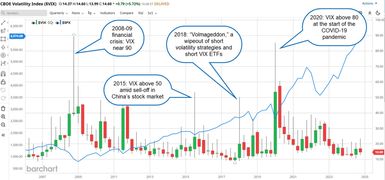
The Cboe Volatility Index (VIX), aka âthe fear gauge,â is the most widely followed and cited volatility gauge for the U.S. stock market. The VIX formula is based on options on the S&P 500 index that expire in a little over three weeks and a little under five weeks, which effectively means that on any given day, the VIX reflects the marketâs 30-day implied volatility.
This article was most recently revised and updated by Doug Ashburn