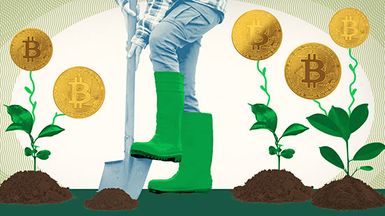
How to grow crypto interest, fees, or rewards.
© domnitsky/stock.adobe.com, © reshoot/stock.adobe.com, © maxbelchenko/stock.adobe.com, © graphixmania/stock.adobe.com; Photo illustration Encyclopædia Britannica, Inc.
Imagine rows of crops on a farm—neatly arranged and optimized to yield the most food possible. Cryptocurrency yield farming is broadly similar, except your objective as the “farmer” is to generate the highest possible yields—interest, fees, or rewards, for example—from your digital assets.
Yield farming, unlike crypto staking, isn’t passive, but rather proactive. It’s a little like intensive crop rotation—to continue the farming analogy—where the farmer strategically adjusts their crop plan to maximize short- and long-term returns. But once a seed has been planted, the farmer is committed for the entire season. In contrast, yield farmers can and do adjust their crypto assets frequently—with the ease of a few keystrokes.
Key Points
- Yield farming is an active strategy designed to maximize your crypto returns.
- Smart contracts can enable automated yield farming.
- As with most things financial, yield farming is risky; higher potential rewards come with higher risks.
Yield farming is the practice of moving cryptocurrency assets across decentralized finance (DeFi) platforms to earn the highest possible returns. Yield farmers earn some combination of interest, rewards, and fees. And because interest rates and rewards fluctuate frequently, farmers have an incentive to actively shift their digital assets to where they can earn the highest current yield.
Yield farmers help supply liquidity (i.e., bids and offers, akin to a market maker) to DeFi platforms. This is core to yield farming, although yield farmers have several ways to participate. They can:
- Deposit assets into liquidity pools to earn fixed or fluctuating yields
- Automatically reinvest gains to compound token returns
- Stake platform-native tokens (received for providing liquidity) to generate additional rewards
- Swap reward tokens for other assets for the purpose of reinvesting
- Use leverage to increase yield farming positions
Yield farming strategies may be multilayered and complex, involving advanced combinations of protocols (i.e., the set of rules that govern a blockchain), tokens, and farming techniques. A yield farmer may contribute tokens to multiple protocols, creating intricate chains of asset allocation to earn rewards that are “stacked.”
How does yield farming work?
Yield farming may be performed manually or automated by smart contracts. If you use a yield farming platform that supports automation, you won’t have to continually identify the DeFi protocol that’s currently offering the best yield. But putting the decision out of your hands and entrusting it to an algorithm has its own risks.
Want to understand how yield farming works, and maybe give it a try? Follow these six steps to get started. But note: As with all things crypto, yield farming is risky. And anytime you put money into something you don’t understand—particularly something automated—you’re playing with fire.
1. Create a digital wallet
Your first step to participate in any kind of decentralized finance activity is to establish a digital wallet. There are plenty of options, although you’ll probably want to choose a wallet that’s widely integrated across DeFi platforms and supports Ethereum (ETH) and the major stablecoins such as Tether (USDT) and USD Coin (USDC). Ethereum and stablecoins are the tokens in DeFi most used for providing liquidity.
The next step is to fund your digital wallet with cryptocurrency—perhaps some mix of Ethereum, USDT, and USDC. You can buy these cryptocurrencies from a centralized or decentralized exchange, then transfer the tokens to your digital wallet. Be sure to choose an exchange that’s compatible with your wallet maker.
If you’re not sure which cryptocurrency to buy or how much, start small. A few dollars’ worth of a couple different cryptocurrencies is enough to plant your first digital seeds as a yield farmer.
3. Select a yield farming platform (unless you’ll be farming manually)
Now you’re ready to select a specific aggregator platform. Conduct plenty of research to understand your alternatives, prioritizing the platforms with the best security.
Yearn and Harvest Finance are two examples of yield farming aggregator platforms that automatically move your funds among different protocols to find the best yields.
4. Deposit tokens into a pool or strategy
Whether you prefer to use a yield farming aggregator platform or farm DeFi yield manually, you’ll need to deposit tokens to begin farming.
- Using an aggregator platform, you can select from the aggregator’s predefined yield farming strategies. The platform automatically transfers your deposited assets to various protocols in alignment with the chosen strategy.
- If you choose to do your own farming, you can identify the DeFi platform currently offering the highest yield and deposit tokens into a liquidity pool associated with that platform.
5. Manage or monitor your yield farming performance
Using a manual yield farming strategy? Then your work is just beginning. You’ll need to continually monitor the DeFi landscape, hunting for the highest yields and moving your assets accordingly.
If you’ve opted for an automated yield farming strategy, then your only ongoing responsibility is to monitor your assets’ performance. Most yield farming aggregators provide dashboards that enable you to view your token balances, current yields, and accumulated rewards.
6. Reinvest or withdraw yield farming rewards
With your yield farming rewards accumulating—assuming you’re earning a positive yield—you may withdraw or reinvest the rewards whenever you feel ready. Automating the reinvestment process—a function that’s supported by many aggregator platforms—may efficiently compound your returns.
Yield farming vs. staking
Yield farming risks and benefits
The possibility of maximizing your cryptocurrency yields may be tempting, but it’s important to recognize that yield farming is risky. (Riskier than the carry trade, junk bond investing, or other high-risk strategies in traditional finance? Absolutely.) One shared trait among DeFi and TradFi (traditional finance) is that risk and reward go hand in hand.
Risks:
- Smart contracts, even with auditing, can contain flaws or vulnerabilities that may be exploited by malicious actors.
- Price volatility and pockets of illiquidity (such as if multiple participants pile in or rush to the exits at the same time) may reduce or negate your returns from yield farming, even putting your initial token investments at risk.
- Yield farming typically involves several DeFi protocols, which can compound the risk—and complexity—associated with the use of multiple platforms.
- DeFi platforms aren’t rated like bonds, which makes it difficult to accurately judge the trustworthiness of the protocol and the team running the platform.
Benefits:
- Yield farming offers potentially high returns using strategies that may be automated.
- Earning different types of tokens across DeFi protocols diversifies your crypto portfolio.
- Yield farming is a way to discover new decentralized finance projects and tokens.
- Flexible exit options enable you to change your strategy or stop farming yield at any time.
The bottom line
Only you can decide if crypto yield farming is right for your objectives and risk tolerance. Are you motivated to conduct the necessary research? Do you feel comfortable taking on a high degree of risk? If so, yield farming may be worth some prudent exploration.
Start small, take precautions to manage your digital assets responsibly, and never invest more than you can afford to lose. Happy farming!
Specific cryptocurrency platforms are mentioned in this article for educational purposes only and not as an endorsement.
This article was most recently revised and updated by Allie Grace GarnettThis article was most recently revised and updated by Doug Ashburn