Encyclopaedia Britannica's editors oversee subject areas in which they have extensive knowledge, whether from years of experience gained by working on that content or via study for an advanced degree. They write new content and verify and edit content received from contributors.
An asset is a resource—whether physical or intangible—that has earning power or some economic value. Assets owned by individuals are personal assets, whereas assets owned by companies—corporations or partnerships, for example—are business assets.
In accounting, assets constitute one of the major sections in a company’s balance sheet, which describes the resources that are under a company’s control on a specified date and indicates where they come from.
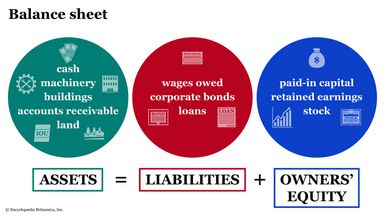
The list of assets describes the company’s resources; the list of liabilities and the owners’ equity indicates where these resources come from. Thus, the balance sheet shows the company’s resources from two points of view—assets and liabilities. Total assets are equal to total liabilities plus total owners’ equity.
This equation can be expressed another way: Total assets minus total liabilities equals total owners’ equity, which emphasizes that the owners’ equity in the company is always equal to the net assets (assets minus liabilities). Any increase in one will inevitably be accompanied by an increase in the other; the only way to increase the owners’ equity is to increase the net assets. This is known as the fundamental accounting equation.
Assets are normally subdivided into current assets and noncurrent assets. Current assets include cash, accounts receivable (from customers and vendors, for instance), inventories, and other assets that are expected to be consumed or can readily be converted into cash during the next operating cycle (production, sale, and collection). Noncurrent assets may include noncurrent receivables, fixed assets (such as land and buildings), intangible assets (such as intellectual property), and long-term investments.
This article was most recently revised and updated by Timothy Lake