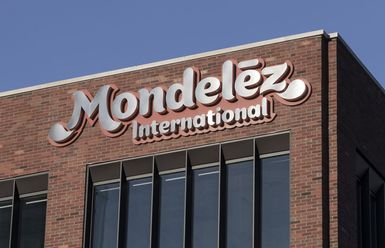
Mondelēz International logo on the company headquarters building in Chicago, Illinois.
© Jonathan Weiss/Dreamstime.com
- Share price:
- $67.54 (mkt close, Nov. 13, 2026)
- Annual revenue:
- $39.90 bil.
- Earnings per share (prev. year):
- $3.17
Mondelēz International is an American global snack manufacturer spun off from Kraft Foods in 2012. A leader in biscuits with a strong portfolio of confectioneries, baked goods, and other snack items, Mondelēz focuses primarily on the high-growth international snack food industry—a market conducive to geographic expansion and product innovation.
The company’s largest business segment—biscuits and cookies under what used to be Kraft’s Nabisco subsidiary—holds a sizable, if not the largest, market share globally. Its chocolate products—many of which were part of Kraft’s 2010 acquisition of Cadbury—also command a significant share in the global confectionery market.
Major business segments and brands
Mondelēz’s business can be broken down into a few key segments, each featuring a portfolio of brands, from the latest trends to iconic names.
Biscuits and cookies
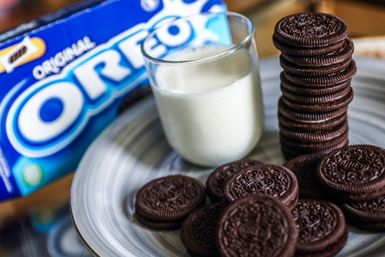
Milk and cookies.
© Jakub Porzycki—NurPhoto/Getty Images
- Oreo sandwich cookies
- Chips Ahoy! chocolate chip cookies
- belVita breakfast biscuits
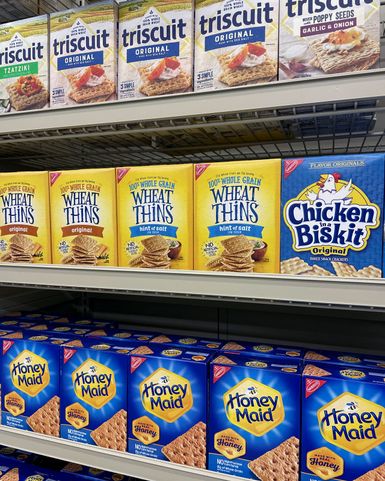
- Honey Maid graham crackers and Teddy Grahams
- Nilla Wafers cookies
- Newtons fruit cookies (including the original Fig Newtons)
- Lorna Doone shortbread cookies
- Ritz crackers
- Triscuit and Wheat Thins whole wheat wafer crackers
- Club Social, the leading cracker brand in Brazil
- Kinh Do, the leading snack brand in Vietnam
Baked snacks
- CLIF protein bars
- 7Days, a Greek snack food company
- Perfect Snacks nutrition bars and snack foods
Chocolate
“Tastes like this feels.”
© Valerie Loiseleux—iStock/Getty Images
- Cadbury, a leading British confectioner
- Hu, maker of “clean label” chocolate and snack foods
- Milka, a chocolate brand based in Germany
- Toblerone, a Swiss chocolatier
- Côte d’Or, a premium Belgian chocolate brand
Gum, candy, and cough drops
- Clorets chewing gum and Stride sugar-free gum
- HALLS cough drops
- Maynards Bassetts, two UK–based candy makers that were combined by Mondelēz in 2016
- Sour Patch Kids candies
- Swedish Fish gummy candies
Beverages
- Bournvita, a chocolate drink brand previously produced by Cadbury
- Tang instant breakfast drink
Other brands
- Philadelphia cream cheese (Kraft owns the U.S. rights, but Mondelēz produces it for the UK and European markets)
- Royal, producer of gelatin, pudding, and baking powder
2011: Announcement of a Kraft Foods split
Since the beginning of her tenure as Kraft Foods CEO, Irene Rosenfeld aimed to reinvigorate the company through international market expansion, business acquisitions, and product innovation.
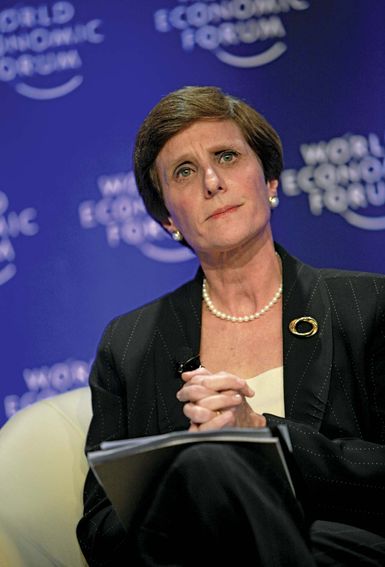
Irene Rosenfeld, 2009.
© World Economic Forum—swiss-image.ch/Sebastian Derungs
During the course of this expansion, particularly after Kraft Foods’ contentious $19.6 billion Cadbury acquisition, it became clear to Rosenfeld that the conglomerate’s growth potential may have been hindered by the lack of synergy between its two distinct business models:
- Its grocery business was relatively stable, yet it operated in a slow-growth industry that was seen as an impediment to innovation.
- Its snacking business, on the other hand, operated in a high-growth industry, one that Rosenfeld believed could present opportunities for international expansion and product diversification.
In August 2011, Kraft announced it would split the company into two entities, each focusing on its distinct model and market.
2012: Kraft Foods spins off Mondelēz International
In October 2012, the Kraft Foods split was officially finalized: Kraft Foods Group (which would later merge with Heinz to become the Kraft Heinz Company) would become the successor to the company’s North American grocery brands, while Mondelēz International, Inc., would chart a new course as an international snack and confectionery company. Kraft Foods Group would be led by a new CEO, Anthony Vernon, while Rosenfeld would lead Mondelēz as CEO (until her retirement in 2017).
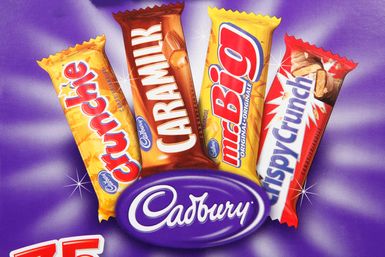
Crunch!
© Billy Blume/Dreamstime.com
Mondelēz began trading on the Nasdaq stock exchange under the ticker symbol MDLZ in 2012. Its name (pronounced mohn-dah-LEEZ) is a portmanteau of Monde, derived from the Latin word “mundus” meaning “world,” and “delez,” which is derived from the word “delicious.” Hence, the name Mondelēz was coined to evoke the notion of “delicious world.”
2013–2020s: Expansion through acquisition and product diversification
Since its spin-off in 2012, Mondelēz International pursued its expansion of markets and products through the acquisition of several domestic and international snack brands. These include:
- Kinh Do (2014): A leading snack company in Vietnam, which allowed Mondelēz to expand into the Southeast Asian market.
- Tate’s Bake Shop (2018): A premium American cookie brand, which allowed Mondelēz to bolster its domestic “premium” cookie and baked dessert portfolio.
- Hu Master Holdings (2020): An American health-conscious snacking company, which gave the company additional exposure to the healthy snack market.
- Grenade (2021): A British performance nutrition brand, which gave Mondelēz a foothold in the UK protein bar and performance snack market.
- Gourmet Food (2021): A premium biscuit company in Australia.
- Chipita (2023): A Greek baked foods company, which gave Mondelēz a presence in central and eastern Europe.
- Clif Bar & Company (2023): Makers of CLIF high-protein bars.
Controversies
Despite its remarkable growth, the company also found itself embroiled in a series of controversies, including:
Many of these controversies were associated with companies acquired by Mondelēz; some of the alleged misconduct occurred before Mondelēz International was founded.
With regard to criticisms of unethical marketing, Mondelēz has faced significant scrutiny, particularly in connection to its key brands Oreo, Chips Ahoy!, and Cadbury. Advertisements for these products, many of which are geared toward kids, feature playful narratives, characters, and formats that are designed for young audiences.
Mondelēz is not the only processed food manufacturer that advertises directly to children using content formats and styles aimed to appeal to them. In response, advocacy groups and health organizations such as the Healthy Living Alliance (HEALA) and the World Health Organization (WHO) have called for stronger regulations to curb this type of marketing, which they view as a significant threat to public health. Although the company has taken steps in recent years to address these and other ethical concerns, multinational corporations—particularly those who specialize in snack foods—must walk a fine line between giving customers what they want and encouraging unhealthy behavior.
Since its establishment in 2012, Mondelēz has been successful in pursuing its corporate vision, growing into a global snack titan with a diverse portfolio of brands in various markets. Despite controversies and a significant decline in earnings per share (EPS) growth in the mid-2010s, the company’s earnings growth rebounded in the early 2020s, perhaps reflecting its commitment to evolving its product lineup and business practices to meet the expectations of the marketplace.
This article was most recently revised and updated by Karl Montevirgen