



- Date:
- November 2, 1880
- Location:
- United States

United States presidential election of 1880
-
What is the United States presidential election of 1880?
In the United States presidential election of 1880, held on November 2, 1880, Republican candidate James A. Garfield defeated Democrat Winfield Scott Hancock. Garfield's popular vote victory remains the narrowest in history among presidents who won the popular vote.
Issues during the campaign included the Republican call for strong tariff protection to curb foreign competition, while Democrats wanted a more relaxed tariff policy. Both parties aimed to restrict Chinese immigration and favored civil service reform, with the Democrats accusing Garfield and his running mate Arthur of political corruption.
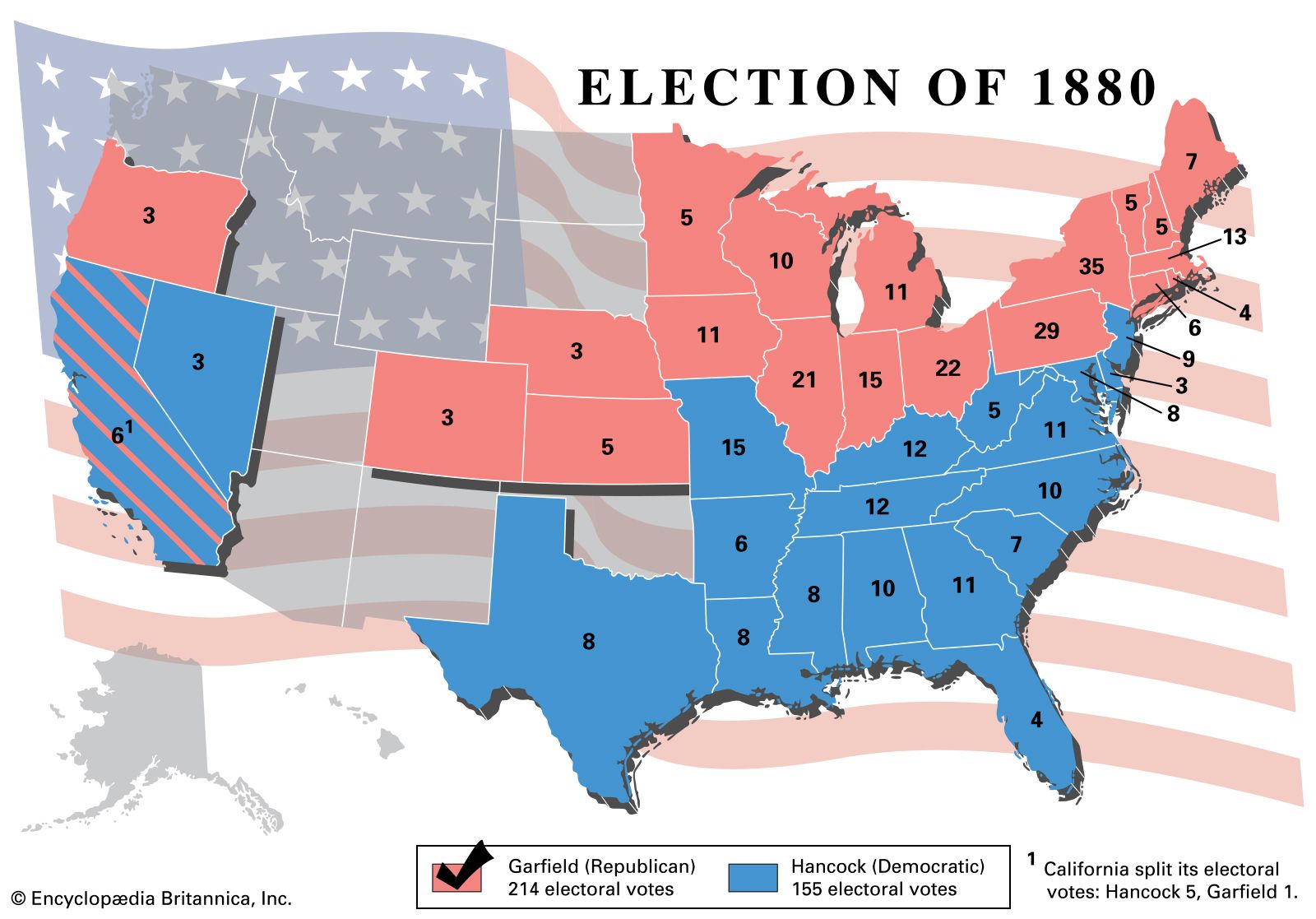
Garfield won the election with 214 electoral votes against Hancock's 155, though the popular vote was much closer. The electoral map showed a sectional divide, with Hancock carrying all former Confederate states and some border states.
2 Britannica SourcesCreated from Britannica articles using AI. AI can make mistakes, so verify using Britannica articles. -
Who were the main candidates in the 1880 presidential election?
The main candidates in the 1880 presidential election were James A. Garfield of the Republican Party and Winfield Scott Hancock of the Democratic Party. Other candidates included James B. Weaver of the Greenback Party and Neal Dow of the Prohibition Party.
Garfield won the election with 214 electoral votes to Hancock’s 155, though the popular vote was much closer. Key issues in the campaign included tariff protection, civil service reform, and Chinese immigration.
1 Britannica SourceCreated from Britannica articles using AI. AI can make mistakes, so verify using Britannica articles. -
Which political parties were involved in this election?
In the 1880 United States presidential election, the main political parties involved were the Republican and Democratic parties. James A. Garfield representing the Republican party won the election against Winfield Scott Hancock, the Democratic candidate.
Other parties that participated were the Greenback Party, which advocated for an expanded currency and government regulation of labor and industry, and the Prohibition Party, which campaigned for the prohibition of manufacturing and selling intoxicating liquors.
3 Britannica SourcesCreated from Britannica articles using AI. AI can make mistakes, so verify using Britannica articles. -
What were some important issues during the campaign?
During the 1880 presidential campaign, several key issues emerged. The Republican Party emphasized the need for strong tariffs to protect against foreign competition, while the Democratic Party advocated for a more relaxed tariff policy. Both parties expressed support for civil service reform, with the Democrats more aggressively highlighting the issue and accusing Republican candidate James Garfield and his running mate Chester Arthur of political corruption. Another shared concern was the restriction of Chinese immigration.
6 Britannica Sources- Reconstruction: The end of Reconstruction
- United States presidential election of 1880: The campaign and the election
- United States presidential election of 1884: The campaign
- United States presidential election of 1888: The election
- Pendleton Civil Service Act
- public administration: The United States
Created from Britannica articles using AI. AI can make mistakes, so verify using Britannica articles. -
How was the winner of the 1880 election decided?
In the United States presidential election of 1880, Republican candidate James A. Garfield won against Democrat Winfield Scott Hancock. Garfield received 214 electoral votes, while Hancock had 155. Although the popular vote was much closer, Garfield triumphed with a narrow margin of fewer than 10,000 votes.
2 Britannica SourcesCreated from Britannica articles using AI. AI can make mistakes, so verify using Britannica articles. -
What effects did the 1880 election have on American politics?
The 1880 presidential election had several notable effects on American politics:
- Stalwart vs. Half-Breed factions The election highlighted divisions within the Republican Party between the Stalwart and Half-Breed factions. Chester A. Arthur, a Stalwart, was nominated for vice president to appease that faction.
- Civil service reform Allegations of political corruption, particularly against James A. Garfield, fueled calls for civil service reform. Garfield's eventual assassination by a disgruntled office seeker further spurred the push for reform.
- Sectional divide The election underscored the country's sectional divide, with Hancock, the Democratic candidate, carrying all former Confederate states and some border states.
- Tariff debate The election brought the tariff issue to the forefront, with Republicans advocating for strong protection and Democrats favoring a more relaxed policy.
- Emergence of the "Solid South" The election revealed the rise of a "Solid South," as Hancock carried all the former Confederate states and three former slave states that remained loyal to the Union.
4 Britannica SourcesCreated from Britannica articles using AI. AI can make mistakes, so verify using Britannica articles.
United States presidential election of 1880, American presidential election held on November 2, 1880, in which Republican James A. Garfield defeated Democrat Winfield Scott Hancock. Among presidents who won the popular vote, Garfield’s margin of victory remains the narrowest in history.
At a glance: the election of 1880
The candidates
Because Pres. Rutherford B. Hayes had pledged to serve only one term, the run-up to the 1880 election saw both major parties eagerly seeking to designate a standard-bearer. The Stalwarts—a conservative faction of the Republican Party that included powerful party leaders such as New York Sen. Roscoe Conkling—favored former president Ulysses S. Grant. Though Grant’s presidency had been marred by scandal, in 1877–79 he had undertaken a well-publicized world tour that boosted his reputation both at home and abroad, and while he did not actively seek the nomination, it was understood that he would accept it if offered. Other Republican elements, however, rejected Grant out of a concern that his nomination would reopen fissures within the party and that a third term would set an unwise precedent. At the nominating convention in Chicago in early June, those opposed to Grant generally backed either Maine Sen. James G. Blaine or Secretary of the Treasury John Sherman. However, neither commanded wide support, and when the convention deadlocked, the anti-Grant faction united around Ohio Rep. James A. Garfield, who had eloquently campaigned for Sherman. Despite his own reluctance to become a candidate, Garfield won the nomination. Chester A. Arthur, a Stalwart who had served as the customs collector for the port of New York City, emerged as Garfield’s running mate.





One of the most-discussed names on the Democratic side was the party’s previous nominee, former New York governor Samuel J. Tilden, who some thought deserved a chance to avenge his controversial loss of four years earlier. As the party’s convention—held in Cincinnati, Ohio, in late June—got under way, however, Tilden declared that he would not be a candidate. Despite challenges from an impressive slate of contenders, Gen. Winfield Scott Hancock, a Union commander during the Civil War and the respected military governor of Louisiana and Texas during Reconstruction, captured the nomination on the second ballot. The Democrats’ vice presidential nominee was former Indiana representative William H. English.
The campaign and the election

Several issues emerged as key concerns during the 1880 campaign. While the Republicans stressed the need for strong tariff protection in an effort to curb foreign competition in the economic marketplace, the Democratic platform called for a more-relaxed tariff policy. Both parties favored civil service reform, although the Democrats pressed the issue more vehemently, accusing both Garfield and Arthur of political corruption. (In particular, Garfield was alleged to have been involved in the Crédit Mobilier Scandal.) An aim to restrict Chinese immigration also featured in both parties’ platforms.
In an era when it was still considered unseemly for a candidate to court voters actively, Garfield conducted the first “front-porch” campaign, from his home in Mentor, Ohio, where reporters and voters went to hear him speak. Hancock demonstrated the potential perils of personally addressing the media, however, when, in a newspaper interview in October, he claimed that “the tariff question is a local question,” a somewhat dubious remark that seemed to highlight his lack of political experience.
On election day Garfield triumphed with 214 electoral votes to Hancock’s 155. The popular vote totals were much closer, though, with Garfield edging Hancock by fewer than 10,000 votes. The electoral map attested to the country’s profound sectional divide, as Hancock carried every state that had belonged to the Confederacy as well as the border states of Missouri, Kentucky, West Virginia, Maryland, and Delaware. Additionally, 3 percent of voters cast ballots for the Greenback Party, which advocated an expanded currency along with government regulation of labor and industry.
The trusted destination for professionals, college students, and lifelong learners.
SUBSCRIBE


For the results of the previous election, see United States presidential election of 1876. For the results of the subsequent election, see United States presidential election of 1884.
Results of the 1880 election
The results of the 1880 U.S. presidential election are provided in the table.
| presidential candidate | political party | electoral votes | popular votes |
|---|---|---|---|
| Sources: Electoral and popular vote totals based on data from the United States Office of the Federal Register and Congressional Quarterly's Guide to U.S. Elections, 4th ed. (2001). | |||
| James A. Garfield | Republican | 214 | 4,454,416 |
| Winfield Scott Hancock | Democratic | 155 | 4,444,952 |
| James B. Weaver | Greenback | 305,997 | |
| Neal Dow | Prohibition | 9,674 | |