

- Also called:
- E. coli O104:H4 outbreak of 2011, German Escherichia coli outbreak of 2011, or German E. coli O104:H4 outbreak of 2011
- Date:
- April 2011 - July 2011
- Location:
- Germany

German E. coli outbreak of 2011
-
What was the German E. coli outbreak of 2011?
The German E. coli outbreak of 2011 was a bacterial disease outbreak caused by a rare strain of E. coli known as O104:H4. It was the deadliest and second-largest E. coli outbreak on record, with 4,321 cases and 50 deaths, mainly in Germany. Roughly 900 cases led to hemolytic uremic syndrome (HUS), causing red blood cell destruction and, in severe instances, kidney failure.
Symptoms of E. coli O104:H4 infection included diarrhea, abdominal cramps, vomiting, and occasionally a low-grade fever. The source was eventually traced to a single lot of fenugreek seeds imported from Egypt.
1 Britannica SourceCreated from Britannica articles using AI. AI can make mistakes, so verify using Britannica articles. -
What is E. coli and how can it affect people?
Escherichia coli (E. coli) is a species of bacteria that inhabits the intestines. People can contract it through contaminated food or water, causing gastrointestinal illness. Symptoms include diarrhea, abdominal cramps, and vomiting. While most infections are self-limiting, dangerous strains like E. coli O104:H4 can cause bloody diarrhea, kidney failure, and even death.
The German E. coli outbreak of 2011 was caused by a rare strain, O104:H4. It resulted in 4,321 cases and 50 deaths. One-third of victims developed hemolytic uremic syndrome (HUS), leading to kidney failure. The source was traced to fenugreek seeds imported from Egypt.
3 Britannica SourcesCreated from Britannica articles using AI. AI can make mistakes, so verify using Britannica articles. -
How did the E. coli outbreak in Germany start?
The German E. coli outbreak of 2011 started in late April 2011, with a few people in Germany hospitalized with hemolytic uremic syndrome (HUS). This prompted German health officials to begin providing case data to the World Health Organization (WHO) on May 1.
Contaminated food was suspected as the source. Initially, the source was traced to a lot of fenugreek seeds imported from Egypt by a German distributor in November 2009. The distributor sold the seeds to about 70 companies, with over 50 located in Germany. The task force believed that this lot of sprouts was the common link between the French and German outbreaks, but also cautioned that other lots may have been contaminated.
1 Britannica SourceCreated from Britannica articles using AI. AI can make mistakes, so verify using Britannica articles. -
What symptoms did people experience during the outbreak?
During the 2011 German E. coli outbreak, early symptoms of infection with E. coli O104:H4 included diarrhea (often bloody), abdominal cramps, vomiting, and occasionally a low-grade fever. In many instances, these infections are self-limiting, and patients recover fully in five to seven days with supportive treatment, such as hydration. However, in the 2011 outbreak, many patients developed hemolytic uremic syndrome (HUS), with symptoms such as fatigue, decreased urination, pallor, decreased consciousness, and a skin rash with hemorrhagic spots.
1 Britannica SourceCreated from Britannica articles using AI. AI can make mistakes, so verify using Britannica articles. -
How did officials try to find the source of the outbreak?
During the 2011 German E. coli outbreak, officials initially suspected contaminated food as the source but struggled to identify the specific item and its origin. The Robert Koch Institute advised against eating cucumbers after traces of the bacterium were found in those imported from Spain. However, follow-up studies failed to confirm these initial findings, and the food safety alert for Spanish cucumbers was lifted.
Attention then shifted to bean sprouts produced at a farm in northern Germany, but tests for the O104:H4 strain came back negative. Later, French health officials linked HUS cases to sprouts near Bordeaux. A European Food Safety Authority task force traced the source to a lot of fenugreek seeds imported from Egypt by a German distributor in 2009. Consumers were discouraged from growing sprouts, and suspected Egyptian seeds were removed from the market.
1 Britannica SourceCreated from Britannica articles using AI. AI can make mistakes, so verify using Britannica articles. -
What was the cause of the outbreak, and what changes were made to prevent it from happening again?
The German E. coli outbreak of 2011, caused by the rare O104:H4 strain of E. coli, led to 4,321 cases and 50 deaths. The source was traced to a single lot of fenugreek seeds imported from Egypt by a German distributor in November 2009.
To prevent future outbreaks, consumers were discouraged from growing sprouts for consumption and advised to avoid eating raw sprouts. Suspected Egyptian seeds were removed from the European market, and a temporary ban was placed on the import of fenugreek seeds from Egypt.
1 Britannica SourceCreated from Britannica articles using AI. AI can make mistakes, so verify using Britannica articles.
German E. coli outbreak of 2011, bacterial disease outbreak that began in Germany in late April 2011 and that was caused by a previously rare strain of E. coli (Escherichia coli) known as O104:H4.
The 2011 E. coli outbreak was the deadliest and the second largest on record—the largest was the Japan E. coli outbreak of 1996, in which more than 12,600 people became infected—and was responsible for a total of 4,321 cases and 50 deaths, most of which occurred in Germany. About 900 cases involved hemolytic uremic syndrome (HUS), in which infection of the gastrointestinal tract by toxin-producing bacteria results in the destruction of red blood cells. Kidney failure, a frequent complication of HUS, was the primary cause of death during the outbreak.
Stages of the outbreak
In late April 2011 a small number of people in Germany were hospitalized with HUS, the cause of which was determined to be a strain of E. coli that produced a substance called Shiga toxin, named for its similarity to toxins produced by the bacterium Shigella dysenteriae. The unusual spike in E. coli-related HUS prompted German health officials to begin providing case data to the World Health Organization (WHO) on May 1.



Over the course of the next several weeks, the outbreak developed slowly; just 138 cases had been reported by the third week of May. By the end of May, however, the number of confirmed cases in Germany had jumped to 373, and more than two dozen additional cases had been reported in other European Union (EU) member states. As many as 12 to 16 deaths had also been reported by local authorities. About the same time, scientists reported that the causative agent appeared to be a strain of E. coli known as O104:H4, a rare form of the bacterium.
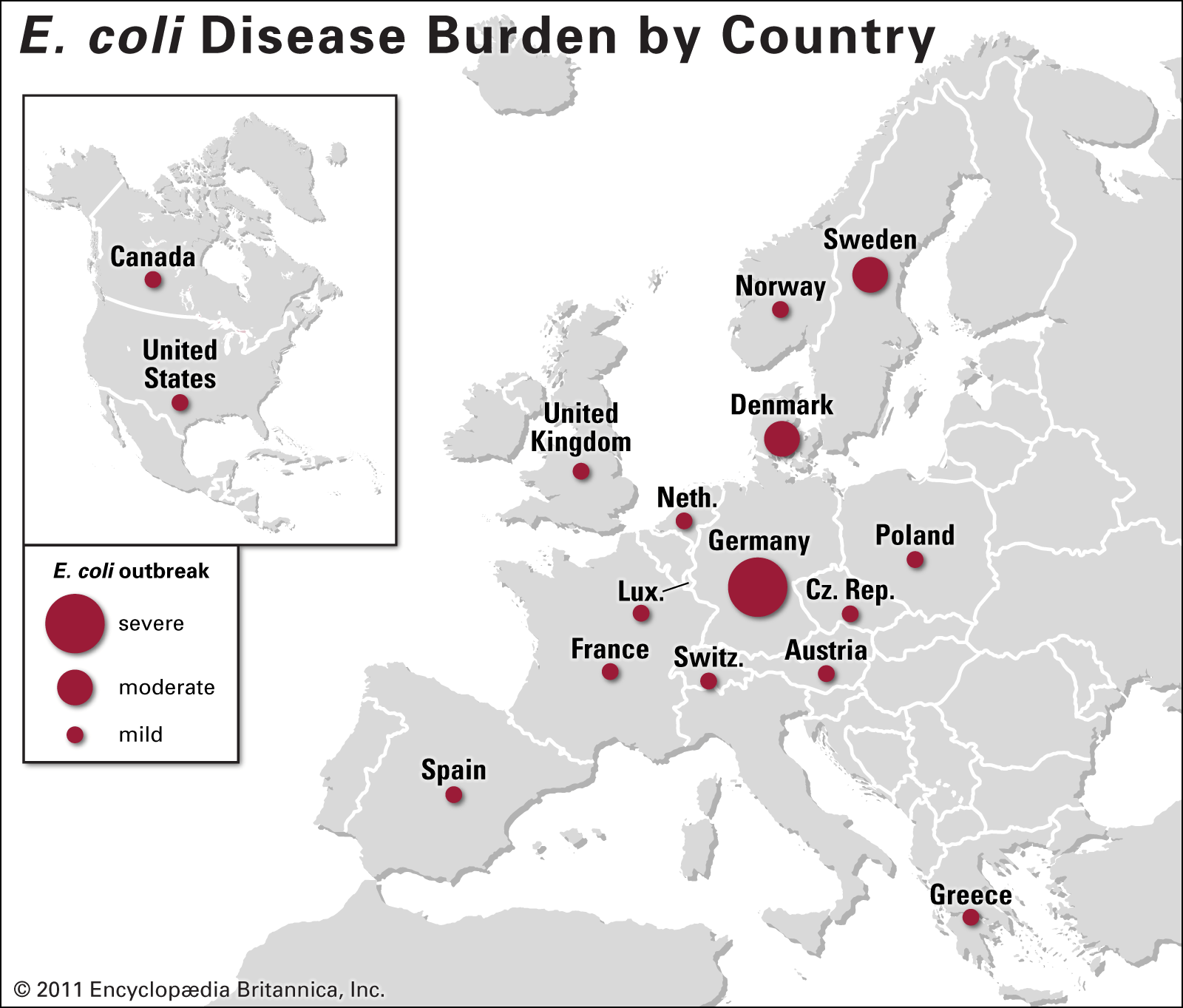
Beginning in early June, the European Centre for Disease Prevention and Control (ECDC), which had been providing daily updates on the number of HUS cases and deaths, also began supplying data on non-HUS E. coli infections, revealing that hundreds of other people were affected, many of whom, for reasons that were unclear, were women. Most cases were reported in and around Hamburg in northern Germany. The minority of cases and deaths reported outside Germany, in places such as Denmark, Sweden, the Netherlands, and the United Kingdom, occurred in persons who had visited the country just prior to their illness.
The number of afflicted rose into the thousands through mid-June, which marked the peak of the outbreak. The last reported onset of illness was documented on July 4. On July 26, after the three-week incubation, diagnosis, and reporting period for infection had passed with no new cases, German officials declared the outbreak over.
Course of infection
Early symptoms of infection with E. coli O104:H4 included diarrhea (often bloody), abdominal cramps, vomiting, and occasionally a low-grade fever. Such E. coli infections often are self-limiting, with supportive treatment (e.g., hydration) facilitating complete recovery within five to seven days. In the O104:H4 outbreak of 2011, however, there was an unusually high rate of progression to HUS, symptoms of which typically appeared within about one week of the onset of diarrhea. Symptoms of the condition included fatigue, decreased urination, pallor, decreased consciousness, a skin rash with hemorrhagic spots (petechiae), and other indications of anemia. Treatment included administration of drugs such as corticosteroids, dialysis, and blood transfusion.
The trusted destination for professionals, college students, and lifelong learners.
SUBSCRIBE

