


St. Maksymilian Maria Kolbe
What is St. Maksymilian Maria Kolbe the patron saint of?
Why was St. Maksymilian Maria Kolbe sent to Auschwitz?
What were St. Maksymilian Maria Kolbe’s last words?
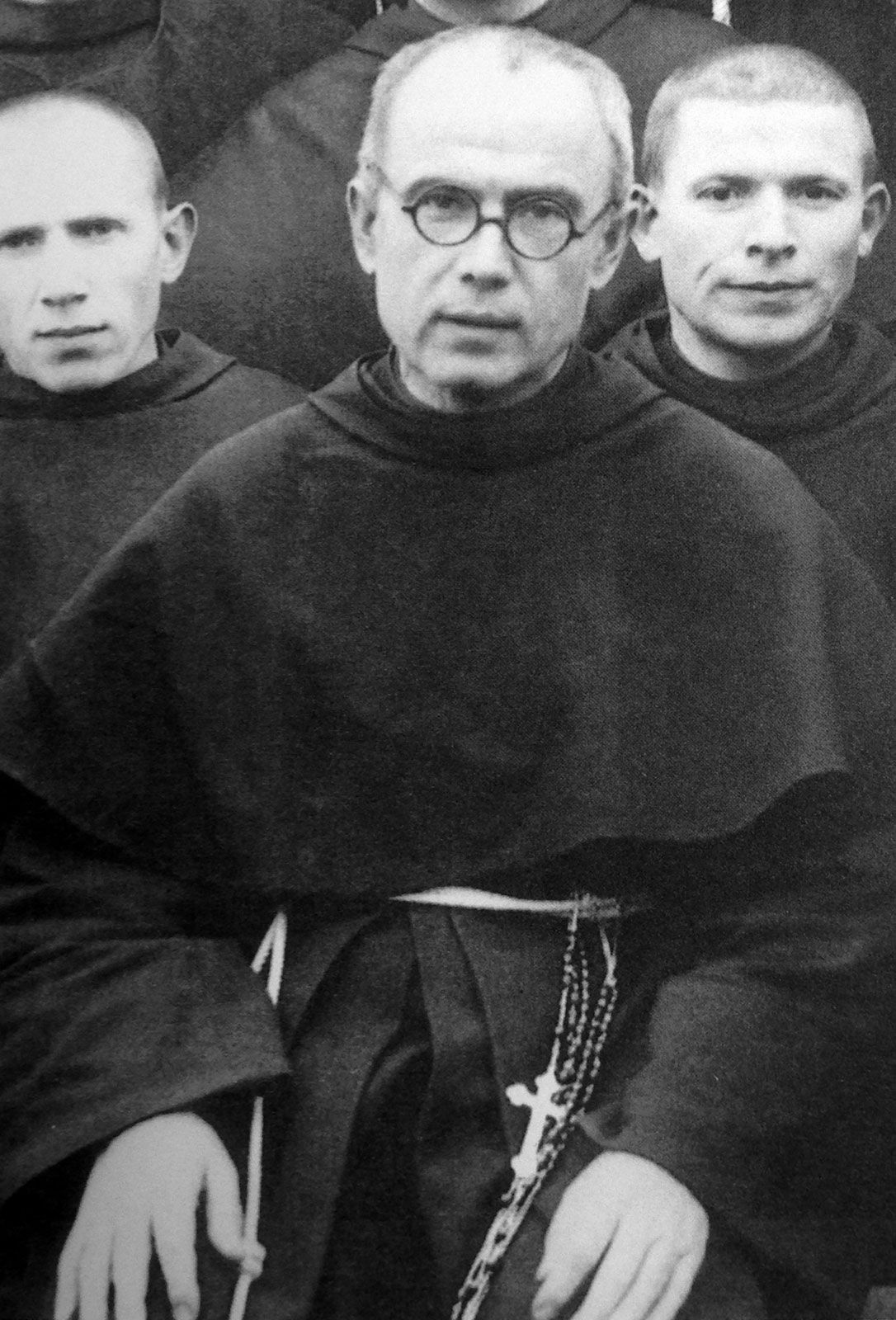
St. Maksymilian Maria Kolbe (born January 8, 1894, Zduńska Wola, near Lodz, Russian Empire [now in Poland]—died August 14, 1941, Auschwitz [now Oświęcim]; feast day August 14; canonized October 10, 1982) was a Franciscan priest and religious founder who was martyred by the Nazis for aiding Jewish refugees during World War II. In the Roman Catholic Church he is venerated as the patron saint of people struggling with substance use disorders and addiction; he is also a patron of political prisoners, journalists, families, and the pro-life movement.
Devotion to the Virgin Mary
In 1906 young Rajmund Kolbe had a vision of the Virgin Mary in which she offered him a white crown and a red crown and asked which he would accept. Understanding the white to represent a life of purity and the red to represent martyrdom, he said he would accept them both. The vision deeply affected him, and the following year he and his elder brother joined the Franciscan Conventuals; at this time Kolbe took the name Maksymilian Maria. In 1912 he went to Rome, where he studied theology and philosophy at the Pontifical Gregorian University. In 1917 he founded the sodality (devotional association) of the Militia of Mary Immaculate, thus making a significant contribution to the international Marian movement. Kolbe was ordained a priest in 1918.
Returning to Poland, he established the popular Roman Catholic periodical Rycerz Niepokalanej (“The Knight of Mary Immaculate”) and in 1927 founded the City of Mary Immaculate (Niepokalanów), a religious center that eventually attracted some 700 friars and workers. A fervent devotee of the Virgin Mary, he later founded sister institutions in Japan and India.




Arrest by the Nazis and martyrdom
Upon his return to Poland, Kolbe became superior of the City of Mary Immaculate and director of Poland’s chief Catholic publishing complex. In 1938 the center started its own radio station. Kolbe was arrested by the Gestapo in 1939 for his anti-Nazism but was later released. He and the remaining brothers used the center to shelter an estimated 2,000–3,000 Polish refugees, the majority of whom were Jewish, and continued to publish anti-Nazi publications.
Kolbe was again arrested in February 1941 on charges of aiding Jews and the Polish underground. He was imprisoned at Warsaw and then shipped to Auschwitz. There he continued his priestly ministry, including hearing confessions and holding mass with smuggled bread, for which he was subjected to beatings by the guards. Following a prisoner’s escape, 10 men were randomly selected to die as punishment, and Kolbe volunteered his life in the place of Franciszek Gajowniczek, who was married with young children. Kolbe and the other nine prisoners were starved for weeks until he and the few others who were still alive were injected with carbolic acid and cremated.
Sainthood
On October 17, 1971, Kolbe was beatified by Pope Paul VI, the first Nazi victim to be proclaimed blessed by the Roman Catholic Church. In 1982 Pope John Paul II canonized him, proclaiming him a “martyr of charity” and “patron of our difficult century.” Gajowniczek survived Auschwitz and attended both the beatification and canonization ceremonies.