


St. Augustine of Canterbury
Who was St. Augustine of Canterbury?
What is St. Augustine of Canterbury the patron saint of?
What was St. Augustine of Canterbury’s mission to England?
What was St. Augustine of Canterbury’s role in the establishment of Canterbury?
St. Augustine of Canterbury (born Rome?—died May 26, 604/605, Canterbury, Kent, England; feast day in England and Wales May 26; General Roman Calendar May 27; traditional calendar May 28 ) was the first archbishop of Canterbury and the apostle to England, who founded the Christian church in southern England.
(What happens when the archbishop of Canterbury is enthroned?)
Probably of aristocratic birth, Augustine was prior of the Benedictine monastery of St. Andrew in Rome, when Pope Gregory I the Great chose him to lead an unprecedented mission of about 40 monks to England, where Christianity had yet to take hold in many parts of the country. They left in June 596, but, arriving in southern Gaul, they were warned of the perils awaiting them and sent Augustine back to Rome. There Gregory encouraged him with letters of commendation (dated July 23, 596), and he set out once more.



The entourage landed in the spring of 597 on the Isle of Thanet, off the southeast coast of England, and was well received by King Aethelberht (Ethelbert) I of Kent, who gave the missionaries a dwelling place in Canterbury and the old St. Martin’s Church, where he allowed them to preach. With Aethelberht’s support, their work led to many conversions, including that of the king. In the following autumn Augustine was consecrated bishop of the English by St. Virgilius at Arles.
Thousands of Aethelberht’s subjects were reportedly baptized by Augustine on Christmas Day 597, and he subsequently dispatched two of his monks to Rome with a report of this extraordinary event and a request for further help and advice. They returned in 601 with the pallium (a vestment that symbolizes a bishop’s metropolitan jurisdiction) from Gregory for Augustine and with more missionaries, including the celebrated saints Mellitus, Justus, and Paulinus. Gregory, with whom Augustine corresponded throughout his apostolate, directed him to purify local temples for Christian worship and to consecrate 12 suffragan bishops; thus, he was given authority over the bishops in Britain, and the evangelization of the Kingdom of Kent began.
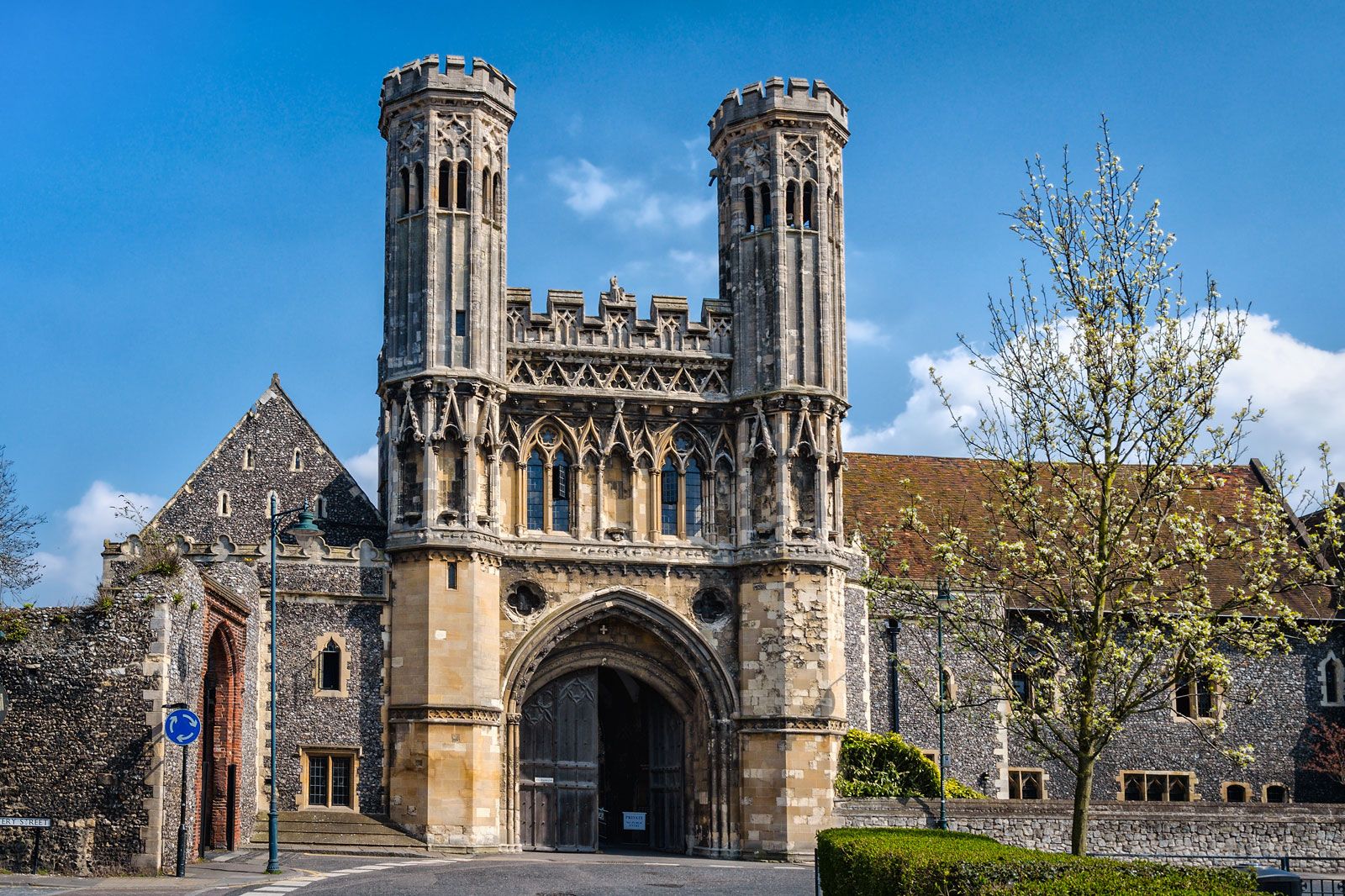
Augustine founded Christ Church, Canterbury, as his cathedral and the monastery of SS. Peter and Paul (known after his death as St. Augustine’s Abbey, where the early archbishops were buried), which came to rank as the second Benedictine house in all of Europe. Canterbury thus was established as the primatial see of England, a position it has maintained. In 604 he established the episcopal sees of London (for the East Saxons), consecrating Mellitus as its bishop, and of Rochester, consecrating Justus as its bishop.
At a conference with British bishops, Augustine tried in vain to unify the British (Celtic) churches of North Wales and the churches he was founding. A second conference, his last recorded act, proved equally fruitless. Augustine was buried at SS. Peter and Paul.
The trusted destination for professionals, college students, and lifelong learners.
SUBSCRIBE

