






- In full:
- Mikhail Vasilyevich Lomonosov
- Born:
- November 19 [November 8, Old Style], 1711, near Kholmogory, Russia
- Died:
- April 15 [April 4], 1765, St. Petersburg (aged 53)
- Founder:
- Moscow State University
- Notable Works:
- “Polnoye sobraniye sochineny”
- Subjects Of Study:
- chemistry
- electricity
- physical chemistry
- glass
- Russian language
- grammar

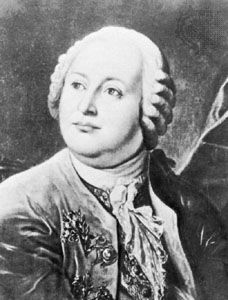
Mikhail Lomonosov
-
Who was Mikhail Lomonosov?
Mikhail Lomonosov (1711–1765) was a Russian polymath, poet, scientist, and grammarian who is considered the first great Russian linguistics reformer. Lomonosov significantly contributed to the natural sciences, reorganized the St. Petersburg Imperial Academy of Sciences, established the University of Moscow, and created the first colored glass mosaics in Russia. Seeking knowledge, he left his village for Moscow in 1730 and was admitted to the Slavonic–Greek–Latin Academy. In 1736, he became a student at the St. Petersburg Academy and later studied at the University of Marburg. After returning to St. Petersburg in 1741, he became a professor in 1745.
1 Britannica SourceCreated from Britannica articles using AI. AI can make mistakes, so verify using Britannica articles. -
What fields did Lomonosov work in?
Mikhail Lomonosov was a polymath whose interests spanned multiple disciplines. He was a poet, scientist, and grammarian, and is considered a founder of the modern Russian literary language.
Lomonosov made significant contributions to the natural sciences, reorganized the St. Petersburg Imperial Academy of Sciences, and founded Moscow State University. He also created the first colored glass mosaics in Russia. His scientific work included contributions to chemistry, physics, and metallurgy.
1 Britannica SourceCreated from Britannica articles using AI. AI can make mistakes, so verify using Britannica articles. -
Why is Lomonosov important in Russian history?
Mikhail Lomonosov (1711-1765) was a Russian polymath of humble origin who made significant contributions to poetry, science, and linguistics, and is considered the first great Russian linguistics reformer. Lomonosov helped to modernize the Russian language by combining Russian and Church Slavonic. He also developed theories of versification that replaced earlier Polish models with syllabotonic verse, which was more suitable for the Russian language. Additionally, Lomonosov reorganized the St. Petersburg Imperial Academy of Sciences and founded Moscow State University.
3 Britannica SourcesCreated from Britannica articles using AI. AI can make mistakes, so verify using Britannica articles. -
What were some of Lomonosov's main scientific discoveries?
Mikhail Lomonosov, a prominent Russian scientist, made significant contributions to various fields. He is often regarded as the first great Russian linguistics reformer.
Lomonosov's scientific work includes his attack on the problem of the structure of matter and the "universal law of nature," the law of conservation of matter and energy. His experiments led to setting up a colored glass works and making mosaics with these glasses. In 1755, he closely followed the development of Moscow State University, for which he had drawn up the plans.
3 Britannica SourcesCreated from Britannica articles using AI. AI can make mistakes, so verify using Britannica articles. -
How did Lomonosov influence Russian literature?
Mikhail Lomonosov significantly influenced Russian literature through his work in codifying and standardizing the literary language. In 1758, he published "Preface on the Use of Church Books in the Russian Language," which combined Russian and Church Slavonic to establish the Russian literary language.
Lomonosov also helped shift Russian verse from syllabic to syllabotonic forms, making it more suitable for the Russian language. His theories on versification, especially those of 1739, are considered by some to mark the beginning of Russian literature. Additionally, he achieved poetic success through his panegyric and spiritual odes, such as "Ode on the Seizure of Khotin".
2 Britannica SourcesCreated from Britannica articles using AI. AI can make mistakes, so verify using Britannica articles. -
In what ways did Lomonosov's work help shape education and science in Russia?
Mikhail Lomonosov significantly shaped Russian science and education. As a scientist, he contributed to various fields and advocated for integrating science with practical applications. Lomonosov also played a key role in developing the Russian literary language by combining Russian and Church Slavonic.
Lomonosov founded Moscow State University in 1755, designing it to be a modern intellectual center. Additionally, he reorganized the St. Petersburg Imperial Academy of Sciences, emphasizing training and publicizing scientific knowledge.
4 Britannica SourcesCreated from Britannica articles using AI. AI can make mistakes, so verify using Britannica articles.
Mikhail Lomonosov (born November 19 [November 8, Old Style], 1711, near Kholmogory, Russia—died April 15 [April 4], 1765, St. Petersburg) was a Russian poet, scientist, and grammarian who is often considered the first great Russian linguistics reformer. He also made substantial contributions to the natural sciences, reorganized the St. Petersburg Imperial Academy of Sciences, established in Moscow the university that today bears his name, and created the first coloured glass mosaics in Russia.
Lomonosov was the son of a poor fisherman. At the age of 10 he too took up that line of work. When the few books he was able to obtain could no longer satisfy his growing thirst for knowledge, in December 1730, he left his native village, penniless and on foot, for Moscow. His ambition was to educate himself to join the learned men on whom the tsar Peter I the Great was calling to transform Russia into a modern nation.
The clergy and the nobility, attached to their privileges and fearing the spread of education and science, actively opposed the reforms of which Lomonosov was a lifelong champion. His bitter struggle began as soon as he arrived in Moscow. In order to be admitted to the Slavonic–Greek–Latin Academy, he had to conceal his humble origin; the sons of nobles jeered at him, and he had scarcely enough money for food and clothes. But his robust health and exceptional intelligence enabled him in five years to assimilate the eight-year course of study; during this time he taught himself Greek and read the philosophical works of antiquity.



Noticed at last by his instructors, in January 1736 Lomonosov became a student at the St. Petersburg Academy. Seven months later he left for Germany to study at the University of Marburg, where he led the turbulent life of the German student. His work did not suffer, however, for within three years he had surveyed the main achievements of Western philosophy and science. His mind, freed from all preconception, rebelled at the narrowness of the empiricism in which the disciples of Isaac Newton had bound the natural sciences; in dissertations sent to St. Petersburg, he attacked the problem of the structure of matter.
In 1739, in Freiberg, Lomonosov studied firsthand the technologies of mining, metallurgy, and glassmaking. Also friendly with the poets of the time, he freely indulged the love of verse that had arisen during his childhood with the reading of Psalms. The “Ode,” dedicated to the empress, and the Pismo o pravilakh rossiyskogo stikhotvorstva (“Letter Concerning the Rules of Russian Versification”) made a considerable impression at court.
After breaking with one of his masters, the chemist Johann Henckel, and many other mishaps, among which his marriage at Marburg must be included, Lomonosov returned in July 1741 to St. Petersburg. The Academy, which was directed by foreigners and incompetent nobles, gave the young scholar no precise assignment, and the injustice aroused him. His violent temper and great strength sometimes led him to go beyond the rules of propriety, and in May 1743 he was placed under arrest. Two odes sent to the empress Elizabeth won him his liberation in January 1744, as well as a certain poetic prestige at the Academy.
While in prison he worked out the plan of work that he had already developed in Marburg. The 276 zametok po fizike i korpuskulyarnoy filosofi (“276 Notes on Corpuscular Philosophy and Physics”) set forth the dominant ideas of his scientific work. Appointed a professor by the Academy in 1745, he translated Christian Wolff’s Institutiones philosophiae experimentalis (“Studies in Experimental Philosophy”) into Russian and wrote, in Latin, important works on the Meditationes de Caloris et Frigoris Causa (1747; “Cause of Heat and Cold”), the Tentamen Theoriae de vi Aëris Elastica (1748; “Elastic Force of Air”), and the Theoria Electricitatis (1756; “Theory of Electricity”). His friend, the celebrated Swiss mathematician Leonhard Euler, recognized the creative originality of his articles, which were, on Euler’s advice, published by the Russian Academy in the Novye kommentari.
The trusted destination for professionals, college students, and lifelong learners.
SUBSCRIBE


In 1748 the laboratory that Lomonosov had been requesting since 1745 was granted him; it then began a prodigious amount of activity. He passionately undertook many tasks and, courageously facing ill will and hostility, recorded in three years more than 4,000 experiments in his Zhurnal laboratori, the results of which enabled him to set up a coloured glass works and to make mosaics with these glasses. Slovo o polze khimi (1751; “Discourse on the Usefulness of Chemistry”), the Pismo k I.I. Shuvalovu o polze stekla (1752; “Letter to I.I. Shuvalov Concerning the Usefulness of Glass”), and the “Ode” to Elizabeth celebrated his fruitful union of abstract and applied science. Anxious to train students, he wrote in 1752 an introduction to the physical chemistry course that he was to set up in his laboratory. The theories on the unity of natural phenomena and the structure of matter that he set forth in the discussion on the Slovo o proiskhozhdeni sveta (1756; “Origin of Light and Colours”) and in his theoretical works on electricity in 1753 and 1756 also matured in this laboratory.
Encouraged by the success of his experiments in 1760, Lomonosov inserted in the Meditationes de Solido et Fluido (“Reflections on the Solidity and Fluidity of Bodies”) the “universal law of nature”—that is, the law of conservation of matter and energy, which, with the corpuscular theory, constitutes the dominant thread in all his research.
To these achievements were added the composition of Rossiyskaya grammatika and of Kratkoy rossiyskoy letopisets (“Short Russian Chronicle”), ordered by the empress, and all the work of reorganizing education, to which Lomonosov accorded much importance.
From 1755 he followed very closely the development of Moscow State University (now Moscow M.V. Lomonosov State University), for which he had drawn up the plans. Appointed a councillor by the Academy in 1757, he undertook reforms to make the university an intellectual centre closely linked with the life of the country. To that end, he wrote several scholarly works including Rassuzhdeniye o bolshoy tochnosti morskogo puti (1759; “Discussion of the Great Accuracy of the Maritime Route”); Rassuzhdeniye o proiskhozhdenii ledyanykh gor v severnykh moryakh (1760; “Discussion of the Formation of Icebergs in the Northern Seas”); Kratkoye opisaniye raznykh puteshestviy po severnym moryam… (1762–63; “A Short Account of the Various Voyages in the Northern Seas”); and O sloyakh zemnykh (1763; “Of the Terrestrial Strata”), which constituted an important contribution both to science and to the development of commerce and the exploitation of mineral wealth.
Despite the honours that came to him, he continued to lead a simple and industrious life, surrounded by his family and a few friends. He left his house and the laboratory erected in his garden only to go to the Academy. His prestige was considerable in Russia, and his scientific works and his role in the Academy were known abroad. He was a member of the Royal Swedish Academy of Sciences and of that of Bologna. His theories concerning heat and the constitution of matter were opposed by the empiricist scientists of Germany, although they were analyzed with interest in European scientific journals.
The persecutions he suffered, particularly after the empress Elizabeth’s death in 1762 (1761, Old Style) exhausted him physically, and he died in 1765. The empress Catherine II the Great had the patriotic scholar buried with great ceremony, but she confiscated all the notes in which were outlined the great humanitarian ideas he had developed. Publications of his works were purged of the material that constituted a menace to the system of serfdom, particularly that concerned with materialist and humanist ideas. Efforts were made to view him as a court poet and an upholder of monarchy and religion rather than as an enemy of superstition and a champion of popular education. The authorities did not succeed in quenching the influence of his work, however. The publication of his Polnoye sobraniye sochineny (“Complete Works”) in 1950–83 by Soviet scholars has revealed the full contributions of Lomonosov, who has long been misunderstood by historians of science.