



- Born:
- July 16, 1801, Elberfeld, Duchy of Berg [Germany]
- Died:
- May 22, 1868, Bonn (aged 66)
- Awards And Honors:
- Copley Medal (1866)
- Subjects Of Study:
- cathode ray
- curve
- duality
- line
- magnetism

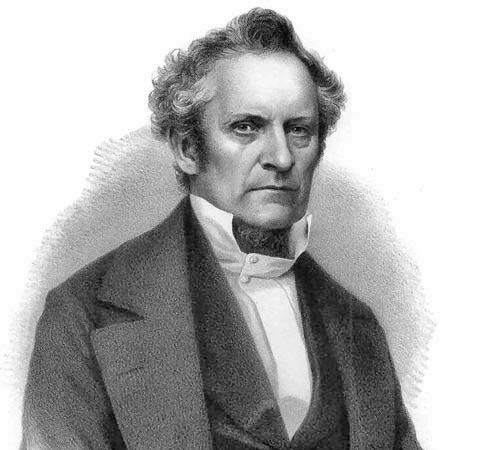
Julius Plücker
Julius Plücker (born July 16, 1801, Elberfeld, Duchy of Berg [Germany]—died May 22, 1868, Bonn) was a German mathematician and physicist who made fundamental contributions to analytic and projective geometry as well as experimental physics.
Plücker attended the universities in Heidelberg, Bonn, Berlin, and Paris. In 1829, after four years as an unsalaried lecturer, he became a professor at the University of Bonn, where he wrote Analytisch-geometrische Entwicklungen, 2 vol. (1828–31; “The Development of Analytic Geometry”). This work introduced abridged notation (a flexible type of mathematical “shorthand”) and exploited the possibility of taking lines rather than points as the fundamental geometric elements. Through this idea, he developed the principle of duality in projective geometry, which states that if a theorem is true, then its dual theorem—obtained by switching dual elements (lines and points) and their corresponding statements—is also true. In 1834 Plücker became a professor of mathematics at the University of Halle before returning to Bonn two years later. In Theorie der algebraischen Curven (1839; “Theory of Algebraic Curves”), he presented the famous “Plücker formulas” relating the number of singularities (points at which a function is not defined or is infinite) on algebraic curves to those of their dual curves. His System der analytischen Geometrie (1835; “System of Analytic Geometry”) introduced the use of linear functions in place of the usual coordinate systems. Plücker’s System der Geometrie des Raumes in neuer analytischer Behandlungsweise (1846; “System of the Geometry of Space in a New Analytical Treatment”) contains a more systematic and polished rendering of his earlier results.
These geometric investigations ran against the strong current associated with mathematician Jakob Steiner’s synthetic school based in Berlin. Sensing this, Plücker turned away from geometry and concentrated on physics. In 1847 he began research on the behaviour of crystals in a magnetic field, establishing results central to a deeper knowledge of magnetic phenomena. At first alone and later with the German physicist Johann W. Hittorf, Plücker investigated the magnetic deflection of cathode rays. Together they made many important discoveries in spectroscopy, anticipating the German chemist Robert Bunsen and the German physicist Gustav R. Kirchhoff, who later announced that spectral lines were characteristic for each chemical substance. In 1862 Plücker pointed out that the same element may exhibit different spectra at different temperatures. According to Hittorf, Plücker was the first to identify the three lines of the hydrogen spectrum, which a few months after his death were recognized in the spectrum of solar radiation.




Following Steiner’s death in 1863, Plücker returned to the study of mathematics with his pioneering work on line geometry, Neue Geometrie des Raumes gegründet auf die Betrachtung der geraden Linie als Raumelement (1868–69; “New Geometry of Space Founded on the Treatment of the Straight Line as Space Element”). He died before finishing the second volume, which was edited and brought to completion by his gifted young pupil Felix Klein.