


- Byname:
- Frank
- Born:
- February 18, 1823, Rossville, Staten Island, New York, U.S.
- Died:
- June 22, 1900, Hastings-on-Hudson, New York (aged 77)
- Movement / Style:
- Gothic Revival
- Hudson River school


Jasper Francis Cropsey
-
Who was Jasper Francis Cropsey?
Jasper Francis Cropsey (1823–1900) was an American painter and architect associated with the second generation of the Hudson River school of artists. Cropsey was known for his autumnal landscapes of the American Northeast. He also designed two churches on Staten Island: Moravian Church (1843) and St. Luke’s Episcopal Church (1845). His paintings of the American landscape were popular in London, where he became known as “America’s painter of autumn.” Cropsey designed a Gothic Revival 29-room mansion called Aladdin in Warwick, New York, and he designed the waiting rooms, stairways, and platforms for 14 elevated train stations on Sixth Avenue in Manhattan.
1 Britannica SourceCreated from Britannica articles using AI. AI can make mistakes, so verify using Britannica articles. -
What kinds of art was Cropsey known for creating?
Jasper Francis Cropsey was an American painter and architect from the second generation of the Hudson River school. He was known for his autumnal landscapes of the American Northeast.
Cropsey was also an architect, designing two churches on Staten Island, Moravian Church (1843) and St. Luke’s Episcopal Church (1845). In the 1850s, Cropsey branched out and painted scenes from allegorical and literary works and Christian subjects, such as The Millennial Age (1854) and The Good Shepherd (1855).
1 Britannica SourceCreated from Britannica articles using AI. AI can make mistakes, so verify using Britannica articles. -
Which art movement did Cropsey belong to?
Jasper Francis Cropsey, an American painter and architect, belonged to the second generation of the Hudson River school of artists. This art movement, which emerged from the Romantic movement, was the first native school of painting in the United States. Cropsey was known for his autumnal landscapes of the American Northeast. Fellow painters like Asher B. Durand, Thomas Cole, Frederic Edwin Church, and George Inness were also associated with the Hudson River school. These artists aimed to portray a pure American landscape untouched by industry and development.
2 Britannica SourcesCreated from Britannica articles using AI. AI can make mistakes, so verify using Britannica articles. -
What are some famous landscapes painted by Cropsey?
Jasper Francis Cropsey, a painter and architect from the Hudson River School's second generation, is famous for his autumnal landscapes of the American Northeast. Some of his famous landscape paintings include Autumn—On the Hudson River (1860) and Richmond Hill in the Summer of 1862 (1862). Cropsey gained recognition as "America’s painter of autumn" during his time in London from 1856 to 1863, where his paintings of the American landscape were very popular.
1 Britannica SourceCreated from Britannica articles using AI. AI can make mistakes, so verify using Britannica articles. -
How did Cropsey's background as an architect influence his paintings?
Jasper Francis Cropsey, an American painter and architect associated with the Hudson River School, initially trained as an architect, which influenced his paintings. His architectural background emphasized precision and detail, evident in his landscapes that meticulously captured the natural world. Cropsey's understanding of spatial relationships and design principles likely informed the composition and structure of his paintings, contributing to their balanced and harmonious qualities. He designed buildings, including two churches on Staten Island, before fully committing to painting. His architectural work provided a foundation for his artistic endeavors, shaping his approach to landscape painting and his unique style within the Hudson River School.
2 Britannica SourcesCreated from Britannica articles using AI. AI can make mistakes, so verify using Britannica articles. -
Why is Jasper Francis Cropsey important in American art history?
Jasper Francis Cropsey was an important figure in American art history as a painter and architect associated with the second generation of the Hudson River school. The Hudson River school was the first native school of painting in the United States. Cropsey was known for his detailed autumnal landscapes of the American Northeast and gained recognition as "America’s painter of autumn".
2 Britannica SourcesCreated from Britannica articles using AI. AI can make mistakes, so verify using Britannica articles.
Jasper Francis Cropsey (born February 18, 1823, Rossville, Staten Island, New York, U.S.—died June 22, 1900, Hastings-on-Hudson, New York) was an American painter and architect associated with the second generation of the Hudson River school of artists. He was known for his autumnal landscapes of the American Northeast.
Cropsey was born the first of eight children and was raised on a farm by devout Christian parents. He suffered from poor health as a child and taught himself to draw and to construct wooden architectural models during periods of convalescence. In 1837, at age 14, he was recognized at the New York City Mechanics’ Institute Fair for his model of a house. Beginning that same year, he held an apprenticeship with architect Joseph Trench. During those years Cropsey learned to paint with watercolour and oil. In 1842 he struck out on his own to establish himself as a professional architect. Over the next two years he designed two churches on Staten Island, Moravian Church (1843; New Dorp) and St. Luke’s Episcopal Church (1845; Rossville, demolished 1945).
During that period he continued to paint as well. On sketching excursions along the Eastern Seaboard, he met painters Asher B. Durand, Thomas Cole, Cole’s student Frederic Edwin Church, and George Inness, all of whom were associated with what later came to be called the Hudson River school. They all aimed to portray in detail a pure American landscape untouched by industry and development. Cropsey went on frequent sketching trips to the Greenwood Lake area in New Jersey, and there he met Maria Cooley, whom he married in 1847. His work was exhibited for the first time in 1843 at the National Academy of Design in New York City, and he continued to exhibit there annually throughout his lifetime.




In 1847 Cropsey and his new wife traveled to Europe and settled in Rome, where they resided in Cole’s former apartment and studio. Cropsey sketched the Italian ruins and landscapes, and he returned with those sketches to the United States in 1849 and used them as studies for his paintings. During the 1850s Cropsey branched out and painted scenes from allegorical and literary works and Christian subjects (e.g., The Millennial Age, 1854; The Good Shepherd, 1855). He and his wife returned with their two daughters to Europe and lived in London from 1856 to 1863. His paintings of the American landscape, especially those of the fall season in the Northeast, were popular there (Autumn—On the Hudson River, 1860; Richmond Hill in the Summer of 1862, 1862), and he became known as “America’s painter of autumn.” While in London he exhibited at the Royal Academy, and in 1861 he was presented to Queen Victoria.
Back in New York City in the 1860s, Cropsey returned to designing architecture while maintaining his painting career. For his family he designed a Gothic Revival 29-room mansion called Aladdin in Warwick, New York (completed 1869; destroyed by fire 1909), and he designed the waiting rooms, stairways, and platforms for 14 elevated train stations on Sixth Avenue in Manhattan (1878). When tastes in painting shifted toward Impressionism, Cropsey’s financial situation faltered, and in 1884 the family (then with four daughters) was forced to give up Aladdin. They settled instead in Hastings-on-Hudson, New York, in a house they called Ever Rest, where Cropsey and his wife lived together until they died.
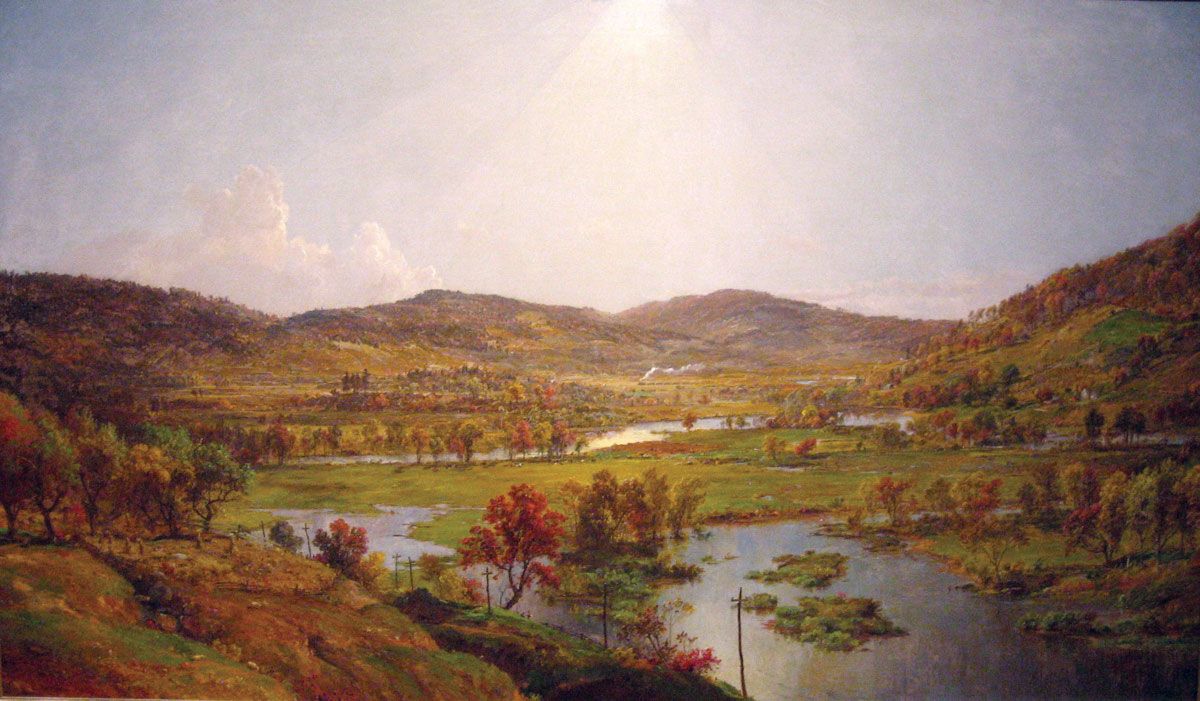
Cropsey’s work came back into fashion in the 1960s when interest in the work of the Hudson River school reemerged. The first retrospective of Cropsey’s work was held in 1968 at the University of Maryland, and numerous exhibitions and catalogs followed. Ever Rest stayed in the Cropsey family and was recognized by the National Register of Historic Places in 1973. It came under the auspices of and was restored by the Newington-Cropsey Foundation in 1977 and into the 21st century served as a museum of Cropsey’s work.