

- In full:
- Adolph Wilhelm Hermann Kolbe
- Born:
- Sept. 27, 1818, Elliehausen, near Göttingen, Hanover [Ger.]
- Died:
- Nov. 25, 1884, Leipzig, Ger. (aged 66)
- Subjects Of Study:
- chemical synthesis
- organic compound
- substitution reaction

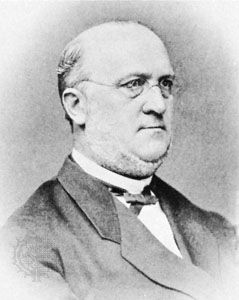
Hermann Kolbe
-
Who was Hermann Kolbe?
Hermann Kolbe (1818–1884) was a German chemist who synthesized organic compounds from inorganic materials. Kolbe studied chemistry under Friedrich Wöhler and Robert Bunsen, eventually earning a professorship at Marburg and later at Leipzig, where a new laboratory was built for him.
Kolbe contributed to molecular composition theories and explored organic acid electrolysis to produce hydrocarbons. With Edward Frankland, he developed a reaction to extend acid size through nitrile formation and hydrolysis. His work led to the chemical structure theory. Kolbe is also known for the Kolbe reaction, used for synthesizing hydrocarbons and salicylic acid. Despite his contributions, Kolbe rejected structural diagrams by August Kekulé, and his unpopular views led to him being viewed as a crank towards the end of his life.
2 Britannica SourcesCreated from Britannica articles using AI. AI can make mistakes, so verify using Britannica articles. -
What is Hermann Kolbe known for in chemistry?
Hermann Kolbe was a German chemist known for accomplishing the first generally accepted synthesis of an organic compound from inorganic materials. In 1844–45, Kolbe published a method for synthesizing acetic acid and first used the word "synthesis" in a chemical context. Kolbe also developed theories of molecular composition and explored the electrolysis of organic acids to produce new hydrocarbons. The Kolbe reaction and Kolbe-Schmitt reaction are named after him.
3 Britannica SourcesCreated from Britannica articles using AI. AI can make mistakes, so verify using Britannica articles. -
What was Kolbe's contribution to the structure of organic compounds?
Hermann Kolbe, a German chemist, significantly contributed to understanding the structure of organic compounds. He developed the theories of molecular composition, influenced by chemists like Friedrich Wöhler and Justus Liebig. Kolbe's investigations of radicals helped determine the detailed constitution of organic substances. For instance, he explored the electrolysis of organic acids to produce new hydrocarbons and, with Edward Frankland, developed a reaction to extend the size of acids.
Kolbe's work played a major role in synthesizing numerous organic substances. Notably, in 1844–45, he published a method for synthesizing acetic acid and first used the word "synthesis" in a chemical context. These efforts contributed to the development of the theory of chemical structure.
2 Britannica SourcesCreated from Britannica articles using AI. AI can make mistakes, so verify using Britannica articles. -
How did Kolbe help develop the idea that organic substances can be made from inorganic materials?
Hermann Kolbe, a German chemist, significantly contributed to the idea that organic substances can be synthesized from inorganic materials. As early as 1844–45, Kolbe published a method for the synthesis of acetic acid from inorganic materials, which was the first example of the total synthesis of an important organic compound.
Prior to Kolbe's work, it was believed that organic compounds could only be produced by living organisms through a "vital force." However, the synthesis of organic substances from inorganic materials disproved the theory of vitalism.
Kolbe further developed theories of molecular composition and explored the detailed constitution of organic substances. His work, including the electrolysis of organic acids, provided means to discern the detailed structure of organic substances.
3 Britannica SourcesCreated from Britannica articles using AI. AI can make mistakes, so verify using Britannica articles. -
What is the Kolbe synthesis, and why is it important?
The Kolbe reaction, or Kolbe synthesis, involves synthesizing a hydrocarbon like ethane through the electrolysis of a salt, such as sodium acetate. Hermann Kolbe, a German chemist, first used the word "synthesis" in a chemical context when publishing a method for synthesizing acetic acid.
Notably, Kolbe's research into organic radicals helped reveal the detailed structure of organic substances. He explored the electrolysis of organic acids to produce new hydrocarbons and, with Edward Frankland, developed a reaction to extend the size of the same acids. The Kolbe-Schmitt reaction is a modification used to synthesize salicylic acid and other phenolic acids.
2 Britannica SourcesCreated from Britannica articles using AI. AI can make mistakes, so verify using Britannica articles. -
How did Hermann Kolbe's work influence modern organic chemistry?
Hermann Kolbe significantly contributed to modern organic chemistry through his work on molecular composition theories. He synthesized acetic acid, which was the first total synthesis of an important organic compound. Kolbe's exploration of organic radicals and electrolysis of organic acids aided in determining the detailed constitution of organic substances. Despite his rejection of the theory of chemical structure developed by August Kekulé, Kolbe's work in the mid-19th century helped set the stage for the development of this theory.
1 Britannica SourceCreated from Britannica articles using AI. AI can make mistakes, so verify using Britannica articles.
Hermann Kolbe (born Sept. 27, 1818, Elliehausen, near Göttingen, Hanover [Ger.]—died Nov. 25, 1884, Leipzig, Ger.) was a German chemist who accomplished the first generally accepted synthesis of an organic compound from inorganic materials.
Kolbe studied chemistry with Friedrich Wöhler at the University of Göttingen and earned his doctorate in 1843 with Robert Bunsen at the University of Marburg (Hesse). After serving as Bunsen’s assistant, Kolbe accepted in 1845 a postdoctoral position in London as assistant to Lyon Playfair, a chemist and a member of the British Parliament. Two years later, Kolbe began working as a scientific editor and writer with the Vieweg publishing house in Braunschweig. In 1851 he finally won a professorship, becoming Bunsen’s successor at Marburg. The circumstances were very unusual, in that he was appointed a full professor without ever having formally qualified for university teaching. But he was highly successful there, both in teaching and research. After 14 years in Marburg, Kolbe accepted a post at the University of Leipzig, where a palatial new laboratory institute was built for him. He remained at Leipzig for the rest of his life.
Kolbe was a leader in the field of organic chemistry just when that field was entering a period of explosive growth. As early as 1844–45, he published a method for the synthesis of acetic acid, the first example of a total synthesis of an important organic compound; in the final paper of this series he used the word synthesis for the first time in a chemical context. Over the next decade or two, numerous organic substances were synthesized, and Kolbe played a major role in this history.




Even more significant for the long term, Kolbe attempted to understand the inner nature of the substances he was manipulating. Powerfully influenced by such chemists as Wöhler, Bunsen, Justus Liebig, and Jöns Jacob Berzelius, Kolbe further developed the theories of molecular composition that had been devised by these chemists. Most chemists of the 1840s adhered to theories of organic radicals, according to which organic molecules were thought to be constructed of—and therefore resolvable into—subcomponent parts (“radicals”) that could also exist independently. Kolbe’s investigations of these radicals gradually provided the means to discern the detailed constitution of organic substances. For example, he explored electrolysis of organic acids that produced new hydrocarbons, and together with his English friend Edward Frankland he devised a reaction that extended the size of the same acids (by means of nitrile formation followed by hydrolysis).
Efforts like these culminated in the development of the theory of chemical structure, by German chemist August Kekulé and others, which emerged just before 1860. Unfortunately, Kolbe categorically rejected the molecular structural diagrams drawn by Kekulé, with his valence bonds between atoms and his carbon chains. Kolbe regarded the classical theory of radicals, which conceived of groups of atoms held together by presumed electrostatic forces, as perfectly sufficient to depict even the most complex organic molecules, and he thought the new structural formulas were excessively speculative. However, virtually all chemists of Kolbe’s age or younger disagreed with him, and the structure theory became well established by about 1870.
When Kekulé’s former student Jacobus Henricus van’t Hoff extended structural formulas into three dimensions in order to create the new specialty field of stereochemistry (1874), Kolbe exploded with anger. As chief editor of a leading journal—the Journal für praktische Chemie—he often published scathing editorials, and in 1877 he viciously excoriated the young and still unknown van’t Hoff. He had also been waging an increasingly unpopular battle against the development of Kekulé’s theory of aromatic compounds (that is, compounds based on the benzene molecule). Unfortunately for Kolbe, stereochemistry, aromatic chemistry, and structural chemistry in general became ever more scientifically useful and more fully accepted; accordingly, by the end of his life Kolbe had generally come to be viewed as an unpleasant crank.
Kolbe gave battle with younger structural chemists not because of ambition, vanity, or spite, but rather because he was committed to high standards of evidence and argument in science, which he thought were being systematically violated by his opponents. Chemistry is a subtle science, requiring sophisticated chains of inference in order to make reliable conclusions about the invisibly small details of molecular architecture. Kolbe was a master at such distant inference; he regarded the methodological style of his opponents as both naive and foolhardy. He never hesitated to defend his science from what he viewed as error. Unfortunately for him, his targets of scorn were among the finest younger chemists of his day.
The trusted destination for professionals, college students, and lifelong learners.
SUBSCRIBE


During the course of his career, Kolbe had close to 2,000 students in his laboratory classes and dozens of postdoctoral or guest workers. Although he dealt harshly in print with those with whom he disagreed, his students were devoted to him. He was one of the finest experimentalists of the 19th century, a true master of the chemical laboratory. He was also, despite his extreme and old-fashioned views, one of the most important theorists during the classical period in the history of organic chemistry.