



- Born:
- May 10, 1746, Beaune, France
- Died:
- July 28, 1818, Paris (aged 72)
- Founder:
- École Polytechnique
- Notable Works:
- “Feuilles d’analyse appliquée à la géométrie”
- Subjects Of Study:
- curvature
- descriptive geometry
- surface

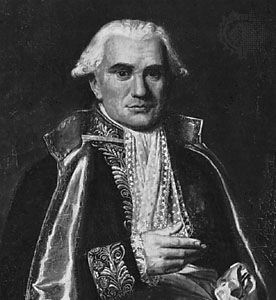
Gaspard Monge, count de Péluse
-
Who was Gaspard Monge?
Gaspard Monge, count de Péluse (1746–1818), was a French mathematician who invented descriptive geometry, which studies how to represent 3D objects on a 2D plane. Although descriptive geometry is no longer an active discipline in mathematics, it is still part of mechanical and architectural drawing.
Monge was also a prominent figure during the French Revolution. He helped establish the metric system and the École Polytechnique. Napoleon I made him a count in 1808.
2 Britannica SourcesCreated from Britannica articles using AI. AI can make mistakes, so verify using Britannica articles. -
What country was Gaspard Monge from?
Gaspard Monge, count de Péluse, was a French mathematician born in Beaune, France, on May 10, 1746. He is credited with inventing descriptive geometry and made significant contributions to the establishment of the metric system and the École Polytechnique. Monge also held public office during the French Revolution and was honoured by Napoleon I in 1808.
1 Britannica SourceCreated from Britannica articles using AI. AI can make mistakes, so verify using Britannica articles. -
What is Gaspard Monge best known for in mathematics?
Gaspard Monge, a French mathematician, is best known for inventing descriptive geometry, which studies mathematical principles to represent 3D objects on a 2D plane. While no longer an active discipline in mathematics, it is part of mechanical and architectural drawing. Monge's lectures formed the basis of his book Géométrie descriptive (1799), where he detailed his method of representing solids in 3D space on a 2D plane using projections. His work revolutionized engineering design and significantly advanced mathematics education.
1 Britannica SourceCreated from Britannica articles using AI. AI can make mistakes, so verify using Britannica articles. -
What is descriptive geometry, and how did Monge contribute to it?
Descriptive geometry is a geometric theory that uses projections to represent 3D objects in a 2D plane. It allows the deduction of projective and metric properties from these representations, typically using two planes at right angles.
Gaspard Monge, a French mathematician, invented descriptive geometry and formalized orthographic projection. His work revolutionized engineering design and significantly advanced mathematics education. Monge's methods were initially classified as a military secret before he was allowed to lecture on them. His book, Géométrie descriptive (1799), detailed how to represent 3D solids on a 2D plane using projections.
3 Britannica SourcesCreated from Britannica articles using AI. AI can make mistakes, so verify using Britannica articles. -
What public roles did Monge hold during the French Revolution?
During the French Revolution, Gaspard Monge held several public roles. He served on the committee that established the metric system in 1791. From 1792 to 1793, he was the minister for the navy and colonies. In 1795, Monge participated in the founding of the National Institute of France. He also supervised foundry operations and wrote handbooks on steelmaking and cannon manufacture when scientists were asked to assist in producing materials for national defense.
1 Britannica SourceCreated from Britannica articles using AI. AI can make mistakes, so verify using Britannica articles. -
How did Gaspard Monge influence science and education in France?
Gaspard Monge, a French mathematician, significantly influenced science and education through his invention of descriptive geometry, which is the study of representing 3D objects on a 2D plane.
Monge helped establish the metric system and the École Polytechnique. During the French Revolution, he contributed to national defense by supervising foundry operations and writing handbooks on steelmaking and cannon manufacture. He taught at the École Normale, where he lectured on descriptive geometry. As an administrator and teacher at the École Polytechnique, he taught descriptive, analytic, and differential geometry. His lectures were edited and published for student use, revolutionizing engineering design and significantly advancing mathematics education.
1 Britannica SourceCreated from Britannica articles using AI. AI can make mistakes, so verify using Britannica articles.
Gaspard Monge, count de Péluse (born May 10, 1746, Beaune, France—died July 28, 1818, Paris) was a French mathematician who invented descriptive geometry, the study of the mathematical principles of representing three-dimensional objects in a two-dimensional plane; no longer an active discipline in mathematics, the subject is part of mechanical and architectural drawing. He was a prominent figure during the French Revolution, helping to establish the metric system and the École Polytechnique. He was made a count in 1808 by Napoleon I.
Monge was educated at the Oratorian schools at Beaune and at Lyon, where for a time at age 16 he was a physics teacher. He made a large-scale plan of Beaune during a visit in 1762, devising methods of observation and constructing the necessary surveying instruments. Impressed with the plan, a military officer recommended Monge to the commandant of the aristocratic military school of Mézières, where he was accepted as a draftsman.
A further opportunity for Monge to display his skill as a draftsman occurred when he was asked to determine gun emplacements for a proposed fortress. At that time such an operation could be performed only by a long arithmetic process, but Monge devised a geometric method that enabled him to solve the problem so quickly that the commandant at first refused to receive his solution. On later careful examination, Monge’s method was classified a military secret. Continuing his researches at Mézières, Monge developed his general method of applying geometry to problems of construction; this subject later became known as descriptive geometry and provided an important stimulus to the rediscovery of projective geometry.




Between 1768 and 1783 Monge taught physics and mathematics at Mézières. During this period his main areas of research were in infinitesimal geometry (applications of calculus to geometry) and the theory of partial differential equations. Prompted by the secretary of the French Academy of Sciences, Marie-Jean Condorcet, he wrote a paper discussing the problem of earthworks (composed in 1776 and reworked in 1781) in which he used calculus to determine the curvature of a surface. The paper is of particular importance not for the practical problem it treated but because of its discussion of the theory of surfaces and its introduction of concepts such as the congruence of straight lines and lines of curvature. His work on partial differential equations, characterized by his geometric point of view and in part inspired by the work of Joseph-Louis Lagrange, led him to the development of extremely fruitful new methods. In 1780 Monge was elected an associate of the Academy of Sciences.
Officially leaving Mézières at the end of 1783, Monge became increasingly active in public affairs in Paris. Between 1783 and about 1789 he was an examiner of naval cadets; he served on the committee of weights and measures that established the metric system in 1791; from 1792 to 1793 he was minister for the navy and colonies and had occasion to welcome the young artillery officer who became Emperor Napoleon I; and in 1795 he participated in the founding of the National Institute of France. Although at times during the French Revolution his position was precarious, Monge continued to be influential. When an appeal was made to scientists to assist in producing materials for national defense, he supervised foundry operations and wrote handbooks on steelmaking and cannon manufacture. In 1794–95 he taught at the short-lived École Normale (later reestablished as the École Normale Supérieure), where he was given permission for the first time to lecture on the principles of descriptive geometry he had developed at Mézières.
Particularly important for mathematics was his substantial role in the founding of the École Polytechnique, which was originally for training engineers and which numbered Lagrange as one of its teachers. Monge was an administrator and an esteemed teacher of descriptive, analytic, and differential geometry. Since no texts were available, his lectures were edited and published for student use. In Géométrie descriptive (1799; “Descriptive Geometry”), based on his lectures at the École Normale, he developed his descriptive method for representing a solid in three-dimensional space on a two-dimensional plane by drawing the projections—known as plans, elevations, and traces—of the solid on a sheet of paper. Feuilles d’analyse appliquée à la géométrie (1801; “Analysis Applied to Geometry”) was an expanded version of his lectures on differential geometry; a later edition incorporated his Application de l’algèbre à la géométrie (1805; “Applications of Algebra to Geometry”) as Application de l’analyse à la géométrie (1807; “Applications of Analysis to Geometry”). Engineering design was revolutionized by his new procedures. Moreover, mathematics education was significantly advanced by his successful texts and popular lectures. Many mathematicians were influenced by his work, notably Jean-Victor Poncelet and Michel Chasles.
Monge was also interested in mechanics and the theory of machines and made contributions to physics and chemistry. In 1796 he became a member of the Commission of Sciences and Arts in Italy and was sent to Italy to choose the paintings and statues that were taken to help finance Napoleon’s military campaigns; many of these works of art went to the Louvre Museum. From 1798 to 1801 he accompanied Napoleon to Egypt, and in Cairo he helped to establish the Institute of Egypt, a cultural organization patterned after the National Institute of France.
The trusted destination for professionals, college students, and lifelong learners.
SUBSCRIBE


With the fall from power of Napoleon in 1814, the Bourbons deprived Monge, a Bonapartist, of all his honours and excluded him in 1816 from the list of members of the reconstituted Institute.