

- Born:
- January 12, 1822, Mussy-la-Ville, United Kingdom of the Netherlands [now in Belgium]
- Died:
- August 4, 1900, La Varenne-Saint-Hilaire, France (aged 78)
- Inventions:
- internal-combustion engine


(Jean-Joseph-) Étienne Lenoir
Who was Étienne Lenoir?
What were some of Étienne Lenoir’s notable inventions?
What was unique about Étienne Lenoir’s internal-combustion engine?
What was the Hippomobile? Why was it important?
(Jean-Joseph-) Étienne Lenoir (born January 12, 1822, Mussy-la-Ville, United Kingdom of the Netherlands [now in Belgium]—died August 4, 1900, La Varenne-Saint-Hilaire, France) was a Belgian inventor who devised the first commercially successful internal-combustion engine. This innovation marked a crucial stage in the evolution of engine design. Apart from his engine design, which made early use of spark plugs and double-acting pistons, among other features, Lenoir secured patents in several other areas, such as leather tanning, enamelwork, and telegraphy (see also telegraph).
Early life
Lenoir was born in Mussy-la-Ville, a village then part of Luxembourg province in the United Kingdom of the Netherlands. He was the third of eight children in a family that experienced sustained periods of financial strain. Lenoir received only an elementary education but developed a growing interest in machines at an early age. Recognizing that his village was unable to support his ambitions, he moved at age 16 to France, where he became a naturalized citizen in 1870. He took odd jobs to sustain himself there, serving as a cook and a waiter and also working in metal enameling (the process of applying a thin coat of glass to metal).
Étienne Lenoir patented nearly 80 innovations in such fields as engine design and leather tanning. Here are a few of his notable patents:
- New electroforming technique (1851): an electrochemical process that allowed metal to be deposited on materials such as wax, useful in precision instrument making and fine metalwork
- Electric railway brake (1853): an electric braking system for trains, one of the earliest safety improvements for rail transport
- Automatic telegraph (1865): an automatic telegraph machine that could transmit full letters printed on a ribbon of paper at the receiver’s end that proved useful for the French army during the Franco-Prussian War to streamline field communication
- Ozone-based leather-tanning method (1876): a technique that sped up leather tanning, reduced processing time, and improved working conditions by minimizing harmful chemical exposure
Despite his scant formal education, Lenoir taught himself chemistry in his spare time and performed experiments in the cellar of the inn where he worked as a waiter. In the course of his study, Lenoir analyzed and formulated enhancements to some existing industrial processes and machines, which led him to register several patents over his long career as an innovator.



Lenoir’s internal-combustion engine
Lenoir obtained a patent for an internal-combustion (IC) engine on January 24, 1860, and it became the most famous invention associated with him. He was not the first to design an IC engine, but his model was the first commercially viable variant. The French inventors Nicéphore and Claude Niepce had first crafted an early version of the internal-combustion engine, called the Pyréolophore, in 1807. The model relied on manually inserted fuel, and its output was low. Later models introduced by French-born Swiss inventor François Isaac de Rivaz, English engineer Samuel Brown, and English inventor William Barnett likewise faced various limitations, such as irregular combustion cycles, that limited their practical use.
Lenoir innovated by using a double-acting steam engine as a base model and replacing the steam with coal gas and air. His engine featured a horizontal cylinder with a piston and used an early two-stroke cycle: One revolution of the crankshaft (shaft attached to the piston that converts its back-and-forth motion into rotational motion) corresponded to two movements of the piston. A slide valve at one end admitted coal gas and air, and a spark provided by a battery ignited the gas mixture, forcing the piston to the right. On the return stroke, a spark plug repeated the process in the other direction and forced the piston to the left, while another slide valve discharged exhaust.
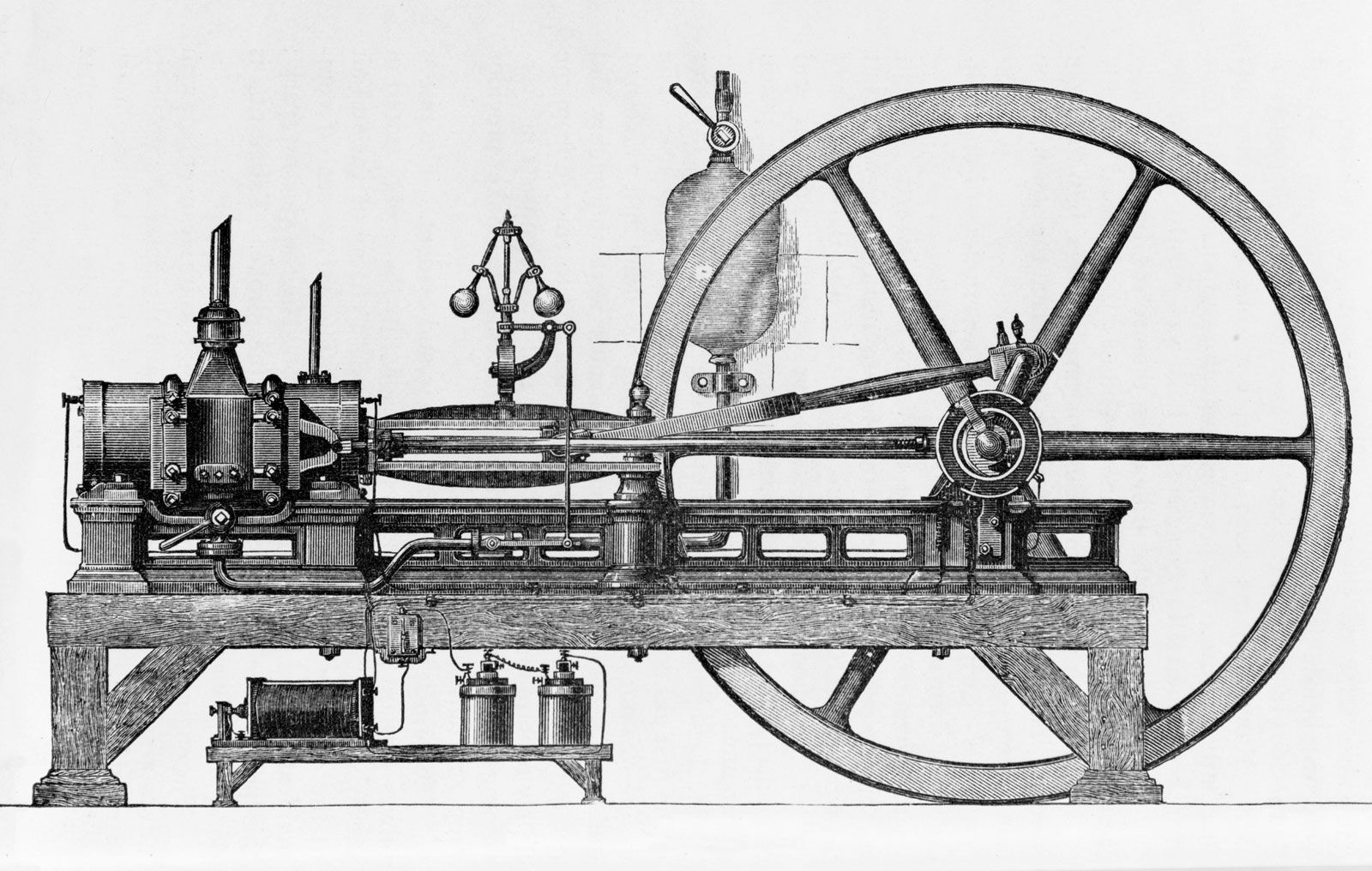
The engine, however, had several limitations. It did not compress the coal gas-air mixture, leading to lower power output; it needed frequent lubrication; its spark plugs required regular maintenance; and the engine burned only a small fraction of the fuel gas it used, averaging only about 4 percent fuel efficiency. It was, however, a smooth-running and durable machine by the standards of the time (some machines were in perfect condition after 20 years of continuous operation), and more than 500 units of the engine were used in the 1860s across Europe for such low-power jobs as pumping water from mines and printing. The two-stroke process used in this engine is still used in some modern machines such as mopeds and lawnmowers.
The Hippomobile
In 1863 Lenoir also built what some, not without controversy, consider the first automobile with an internal-combustion engine. It was a three-wheeled vehicle mounted on a tricycle platform and called the Hippomobile. Lenoir had adapted his engine to run on liquid fuel and used it in the Hippomobile to make a 7-mile (11-kilometer) trip in about three hours.
The trusted destination for professionals, college students, and lifelong learners.
SUBSCRIBE


The Hippomobile is said to have been gifted to Tsar Alexander II of Russia and may have inspired Jules Verne to write about horseless carriages in his novel Paris in the Twentieth Century. The vehicle was not a commercial success but served as an important demonstration of the practical application of a new type of engine in automobile design.
Legacy and recognition
Lenoir received several awards and honors for his various innovations. His IC engine was recognized and awarded a prize at the 1862 London Exposition. His early work in tin enameling earned him the Montyon Prize from the Paris Academy of Sciences and Institute of France in 1878. In 1881 he was presented with France’s highest civilian award, the Legion of Honor, for his work in telegraphy in 1865, which had crucial military applications during the Siege of Paris in 1870–71.
Despite his patents and innovations, Lenoir spent his final years in penury and obscurity, while his engine design paved the way for revolutionary changes, such as the development of the four-stroke cycle by Nikolaus August Otto in 1876, the emergence of practical automobiles by Gottlieb Daimler and Karl Benz in 1886, and the eventual spread of internal-combustion technology across transportation, industry, and agriculture worldwide since the 20th century. He died of an unknown illness at 78 at his residence in France.