

- Also called:
- Geoffroy L’aîné, orGeoffroy The Elder
- Born:
- Feb. 13, 1672, Paris, Fr.
- Died:
- Jan. 6, 1731, Paris (aged 58)
- Subjects Of Study:
- chemical reaction

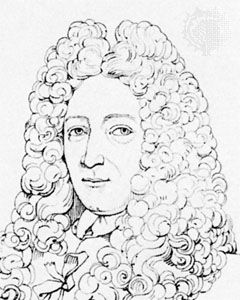
Étienne-François Geoffroy
Étienne-François Geoffroy (born Feb. 13, 1672, Paris, Fr.—died Jan. 6, 1731, Paris) was a French chemist, the first chemist to speak of affinity in terms of fixed attractions between different bodies.
Assuming that one acid displaces another acid of weaker affinity for a specific base in the salt of that base, Geoffroy composed tables (1718) listing the relative affinities of different reagents for particular substances. Geoffroy’s tables remained an authoritative reference throughout most of the 18th century, until they were invalidated by Claude-Louis Berthollet’s demonstration that the thoroughness of chemical reactions depends upon the relative quantities of the starting materials and the physical conditions pertaining during the reaction.
Geoffroy was professor of chemistry at the Jardin du Roi, Paris, and of pharmacy and medicine at the Collège de France, Paris (1712–31). He considered the quest for the philosopher’s stone (a substance capable of transforming base metals into gold) a delusion, but he believed that iron could be formed during the combustion of vegetable matter. His works included Tractatus de Materia Medica (1699; “Treatise on Pharmacology”).



