
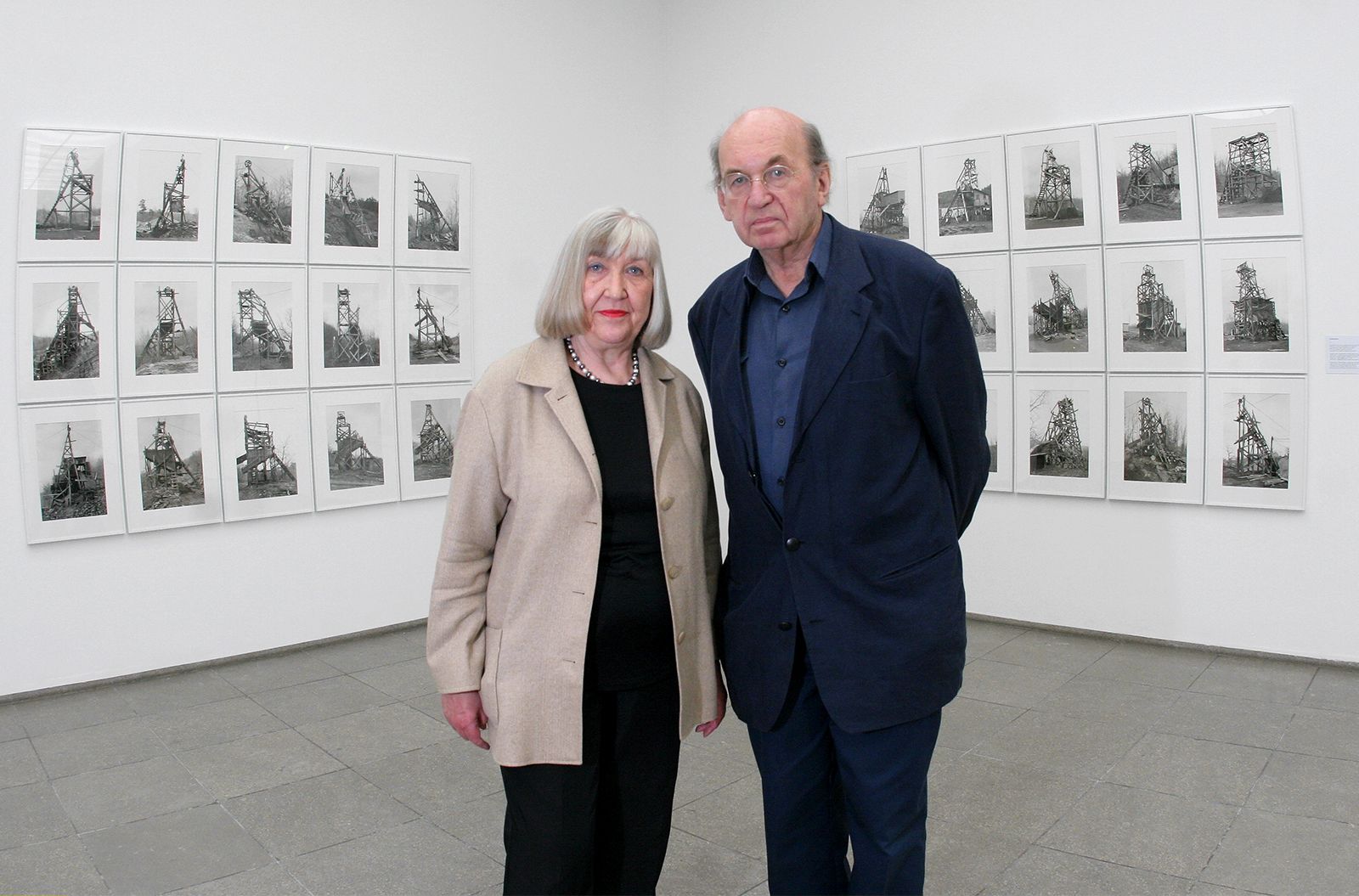

Bernd Becher and Hilla Becher
- Née: Hilla Wobeser
- Born: September 2, 1934, Potsdam, Germany
- Died: October 10, 2015, Düsseldorf, Germany
-
Who were Bernd Becher and Hilla Becher?
Bernd Becher (1931–2007) and Hilla Becher (1934–2015) were influential German photographers celebrated for their black-and-white images of industrial structures.
For nearly 50 years, the duo systematically photographed industrial buildings, including water towers, blast furnaces, and grain elevators, most of which have since been demolished. They strived to eliminate any trace of subjectivity in their compositions by choosing a fixed vantage point and photographing on cloudy days to avoid shadows.
The Bechers' "objective" style was rooted in the Neue Sachlichkeit movement. Together, they established a photography department at the Staatliche Kunstakademie in Düsseldorf in 1976, influencing many contemporary photographers and originating what became known as the Düsseldorf School of Photography.
1 Britannica SourceCreated from Britannica articles using AI. AI can make mistakes, so verify using Britannica articles. -
What kind of photographs did they take?
Bernd and Hilla Becher are renowned for their black-and-white photographs of industrial structures, such as water towers and blast furnaces. Their work, spanning nearly five decades, features a consistent style characterized by a fixed vantage point, aiming to eliminate subjectivity. They avoided shadows by photographing on cloudy days, which gave their images a reductive, expressionless quality.
The Bechers presented their photographs of similar structures in grids, creating what they termed "typologies," to encourage close examination and comparison. Their objective style was influenced by the Neue Sachlichkeit ("New Objectivity") movement.
2 Britannica SourcesCreated from Britannica articles using AI. AI can make mistakes, so verify using Britannica articles. -
Why are their photographs mostly of industrial buildings?
Bernd and Hilla Becher, German photographers, are known for their black-and-white images of industrial buildings. For nearly 50 years, they systematically photographed industrial structures such as water towers, blast furnaces, and grain elevators, most of which dated to the 19th century.
The Bechers strived to eliminate any trace of subjectivity by choosing a fixed vantage point and photographing on cloudy days to avoid shadows, lending their images an airless quality. They were interested in form and function and juxtaposed images to examine differences in size, materials, and shapes when the machine's function was the same. The Bechers hoped their documentation would serve as the memory of the quickly forgotten and obsolete. Their style of documentation found its source in the Neue Sachlichkeit movement.
2 Britannica SourcesCreated from Britannica articles using AI. AI can make mistakes, so verify using Britannica articles. -
What style or technique did they use in their photography?
Bernd and Hilla Becher were German photographers known for their black-and-white images of industrial buildings. They systematically photographed structures like water towers and blast furnaces, primarily from the 19th century.
The Bechers adopted a signature style, maintaining it for nearly 50 years. They chose a fixed vantage point to eliminate subjectivity and photographed on cloudy days to avoid shadows, giving their images an expressionless quality. This method resulted in straightforward images that highlighted the geometry of the structures. They often displayed photos of similar structures in grids called "typologies" to encourage close examination and comparison.
Their objective style was rooted in the Neue Sachlichkeit ("New Objectivity") movement, which rejected sentimentality in favor of sharply focused, detailed imagery.
2 Britannica SourcesCreated from Britannica articles using AI. AI can make mistakes, so verify using Britannica articles. -
How did their work influence photography and other artists?
Bernd and Hilla Becher, German photographers known for their objective style, significantly influenced photography and other artists through their systematic documentation of industrial structures.
Their work, characterized by black-and-white images of industrial buildings, found its source in the Neue Sachlichkeit movement. The Bechers' objective style influenced artists reacting against the romantic landscape aesthetic. Their participation in the "New Topographics" exhibition in 1975-76 highlighted a dispassionate approach to capturing the man-altered landscape.
As professors at the Staatliche Kunstakademie in Düsseldorf, they influenced contemporary photographers, notably Bernd's students Thomas Struth, Thomas Ruff, Candida Höfer, and Andreas Gursky, who formed the Düsseldorf School of Photography.
1 Britannica SourceCreated from Britannica articles using AI. AI can make mistakes, so verify using Britannica articles. -
What is the 'Becher School,' and how is it connected to their legacy?
The "Becher School," more accurately known as the Düsseldorf School of Photography, emerged from the photography department that Bernd Becher and Hilla Becher established in 1976 at the Staatliche Kunstakademie in Düsseldorf. Bernd Becher became its first professor, influencing many contemporary photographers, including Thomas Struth, Thomas Ruff, Candida Höfer, and Andreas Gursky. Their objective style of documentation found its source in the Neue Sachlichkeit movement. The Bechers' distinctive styles and successful careers cemented their legacy and the recognition of the Düsseldorf School.
1 Britannica SourceCreated from Britannica articles using AI. AI can make mistakes, so verify using Britannica articles.
Bernd Becher and Hilla Becher were German photographers known for their straightforward black-and-white images of types of industrial buildings. For nearly five decades, the couple systematically photographed individual industrial structures—water towers, blast furnaces, grain elevators, framework (half-timber) houses—most of which dated to the 19th century and have since been demolished.
Bernd studied painting and lithography at the Staatliche Kunstakademie in Stuttgart, Germany, from 1953 to 1956 and went on to study typography in Düsseldorf, Germany, at the Staatliche Kunstakademie from 1957 to 1961. His first experiments in photography were in 1957, at which point he was already interested in functional buildings of industry and started documenting those that he had seen around his hometown of Siegen. Hilla studied photography in Potsdam, Germany, worked as an aerial photographer briefly in Hamburg, and moved to Düsseldorf in 1959. The couple met there that year, began collaborating, and married in 1961.
The Bechers’ photographs are instantly recognizable. They established a signature style from their earliest work and continued in that mode for nearly 50 years. By choosing a fixed vantage point from which to capture the elements of the industrial landscape, the Bechers strove to eliminate any trace of subjectivity in their compositions. In order to avoid shadows, they photographed on cloudy days, lending their images an airless and expressionless quality. The cumulative effect of their method was a straightforward reductive image of the geometry of their subject. The viewer’s eye has no choice but to examine the intricacies of the otherwise mundane structures and machines. To further encourage close examination and active comparison of structural features, they exhibited their photographs of similar types of structures in grids, creating “families of objects.” They called those ordered sets of photographs “typologies.” The Bechers were interested not only in form but also in function. They juxtaposed images to examine differences in form (size, materials, shapes) when the basic function of the machine or site was the same.



Though the Bechers’ oeuvre may appear obsessive and encyclopaedic, their goal was not just systematic documentation. The couple had strong views regarding preservation and hoped that their documentation would serve as the memory of the quickly forgotten and the obsolete. They photographed industrial structures in Germany, especially in the Ruhr region, and throughout Europe, as well as in many regions of North America.
Despite the couple’s resistance to categorization, their work was integrated into the Minimalist and Conceptual art discourse of the 1960s and ’70s. And, within the photography field, the Bechers became associated with a new flock of artists working in reaction to the romantic landscape aesthetic. The Bechers and eight other photographers, including Lewis Baltz, Frank Gohlke, Stephen Shore, and Robert Adams, participated in a pivotal exhibition titled “New Topographics: Photographs of a Man-Altered Landscape” in 1975–76 at the George Eastman House in Rochester, New York. “New Topographics” put a name to the photographers who were capturing the built environment in a dispassionate and impersonal way. Their new version of the American landscape—a radical departure from the traditional photographic landscape by artists such as Ansel Adams—drew attention to a new, somewhat troubling, understanding of the relationship between the individual and nature. Those photographers also had returned to shooting with large- and medium-format cameras in contrast to the lightweight Leicas, which had been the camera of choice for the previous generation of street photographers. The New Topographic photographers adhered to conventional printing methods when the aesthetic trends of the 1970s were moving decidedly toward color, abstraction, and alternative printing methods and materials.
The Bechers’ sharply focused “objective” style of documentation found its source in the Neue Sachlichkeit (“New Objectivity”) movement, which had emerged in Germany in the 1920s. The group, which included photographers such as August Sander, Karl Blossfeldt, and Albert Renger-Patzsch, rejected the sentimentality of Pictorialism, a school of photography then losing momentum, which emphasized the beautiful, painterly, and well-composed image.
Together the Bechers established a photography department in 1976 at the Staatliche Kunstakademie in Düsseldorf, and Bernd became its first professor, a position he held until 1996. He and his wife influenced many contemporary photographers, and Bernd taught four of the best-known photographers to emerge from Germany in the late 20th century: Thomas Struth, Thomas Ruff, Candida Höfer, and Andreas Gursky. Their styles were so distinctive and their careers so successful that they came to be known as the Düsseldorf School of Photography. The Bechers were awarded the Golden Lion for sculpture at the 1990 Venice Biennale, and in 2004 they won the Hasselblad Foundation International Award “for their outstanding achievements in the field of photography.”
The trusted destination for professionals, college students, and lifelong learners.
SUBSCRIBE

