


Beyond the bailout
An agreement in May 2016 between Greece and its creditors released another $11.5 billion tranche that allowed Greece to make its debt payments in July and set the stage for consensus on a plan that would provide debt relief for Greece by 2018. In August 2018 Greece officially ended its reliance on the bailout provided by the ECB, the EU, and the IMF, having borrowed a total of more than $330 billion. Under the Tsipras regime Greece’s GDP had grown by 1.5 percent in 2017, and, excluding debt repayments, the country appeared to have accrued a budget surplus of about 4 percent in 2016 and 2017. Nonetheless, the Greek economy was about one-fourth smaller than it had been before the crisis. Moreover, the draconian measures that had brought solvency—including layoffs, reduced pensions, and tax increases—had taken a toll on the quality of life for many Greeks.
On the other hand, Tsipras registered a major diplomatic success in June 2018 when he and Macedonian Prime Minister Zoran Zaev announced that they had reached an understanding regarding the long-standing dispute over Macedonia’s name. Under the agreement (which became known as the Prespa Agreement by virtue of its signing on the banks of Lake Prespa), Macedonia would be known both domestically and internationally as the Republic of North Macedonia, a change that Greece had stipulated must be reflected in Macedonia’s constitution. On January 11, 2019, the multistage process required for amending the constitution was completed when just over two-thirds of the Macedonian parliament approved the name change. According to the Prespa Agreement, the final stage in formal adoption of the name change was approval by the Greek parliament. With voting on the matter imminent, Defense Minister Panos Kammenos, the leader of the ruling coalition’s junior partner, the Independent Greeks, resigned his office in protest. Facing near-certain rejection of the agreement by the opposition ND and with his wafer-thin majority eliminated by the departure of the Independent Greeks from the coalition, Tsipras chose to call for a vote of confidence in his government. He narrowly survived that vote—held in the waning hours of January 16, 2019—finishing on the plus side of a 151–148 count by maintaining the support of rebellious Independent Greeks and independent MPs. Following three days of heated debate, on January 25 parliament approved the Prespa Agreement with two votes to spare by a 153–146 margin. Although opinion polling indicated that a majority of Greeks opposed the agreement, the vote laid the groundwork for Greece to remove its objection to Macedonian membership in NATO, thus paving the way for official adoption of Macedonia’s new name.
Fall from power
The Greek economy continued to grow in 2018 but slowly, as GDP expanded by only about 2.1 percent, according to the IMF. By August 2018 the unemployment rate had fallen dramatically to 19.5 percent. However, it remained much higher for young Greeks, and ongoing frustration with the sluggish economic recovery contributed to the shellacking Syriza took at the hands of ND in elections for the European Parliament in May 2019. Responding to those results, Tsipras called a snap election for the Greek parliament to be held in early July. Kyriakos Mitsotakis, son of former prime minister Konstantinos Mitsotakis, led ND into the election with promises of kick-starting the economy by cutting taxes, privatizing public services, and renegotiating the country’s debt, all of which apparently appealed to the electorate, which handed ND a resounding victory. Syriza took just some 31.5 percent of the vote, whereas ND garnered nearly 40 percent, enough to claim an absolute majority with 158 seats in parliament, leading to Tsipras’s replacement as prime minister by Mitsotakis on July 8.
The 2023 parliamentary elections
Tsipras did not prove to be a particularly effective opposition leader. Although confronted with the challenge of trying to right the economy during the COVID-19 global pandemic, Mitsotakis succeeded in squiring the Greek GDP to growth of about 8 and 6 percent in 2021 and 2022, respectively. When the Greek electorate voted in the 2023 parliamentary elections, there seemed to be a sense that Tsipras lacked a vision of the future strong enough to compete with the restoration of economic stability that Mitsotakis had helped achieve. In voting in May, Syriza was able to capture only about 20 percent of the votes cast, compared with more 40 percent for ND. Short of an absolute majority and unwilling to lead a coalition government, Mitsotakis gave way to a caretaker government so that Greeks could return to the polls in late June. This time, benefiting from a rule that allotted bonus parliamentary seats to the party that won the most votes, Mitsotakis got his majority, as ND again claimed more than 40 percent of the vote. Even though Syriza’s portion of the vote fell to about 18 percent, Tsipras gave no indication that he intended to step down as party leader. In June 2023 Tsipras resigned as the leader of Syriza but remained one of the most influential figures of the Greek left. More than two years later, in October 2025, he resigned from his parliamentary seat with plans of launching a new party.
Return to politics and the formation of ELAS
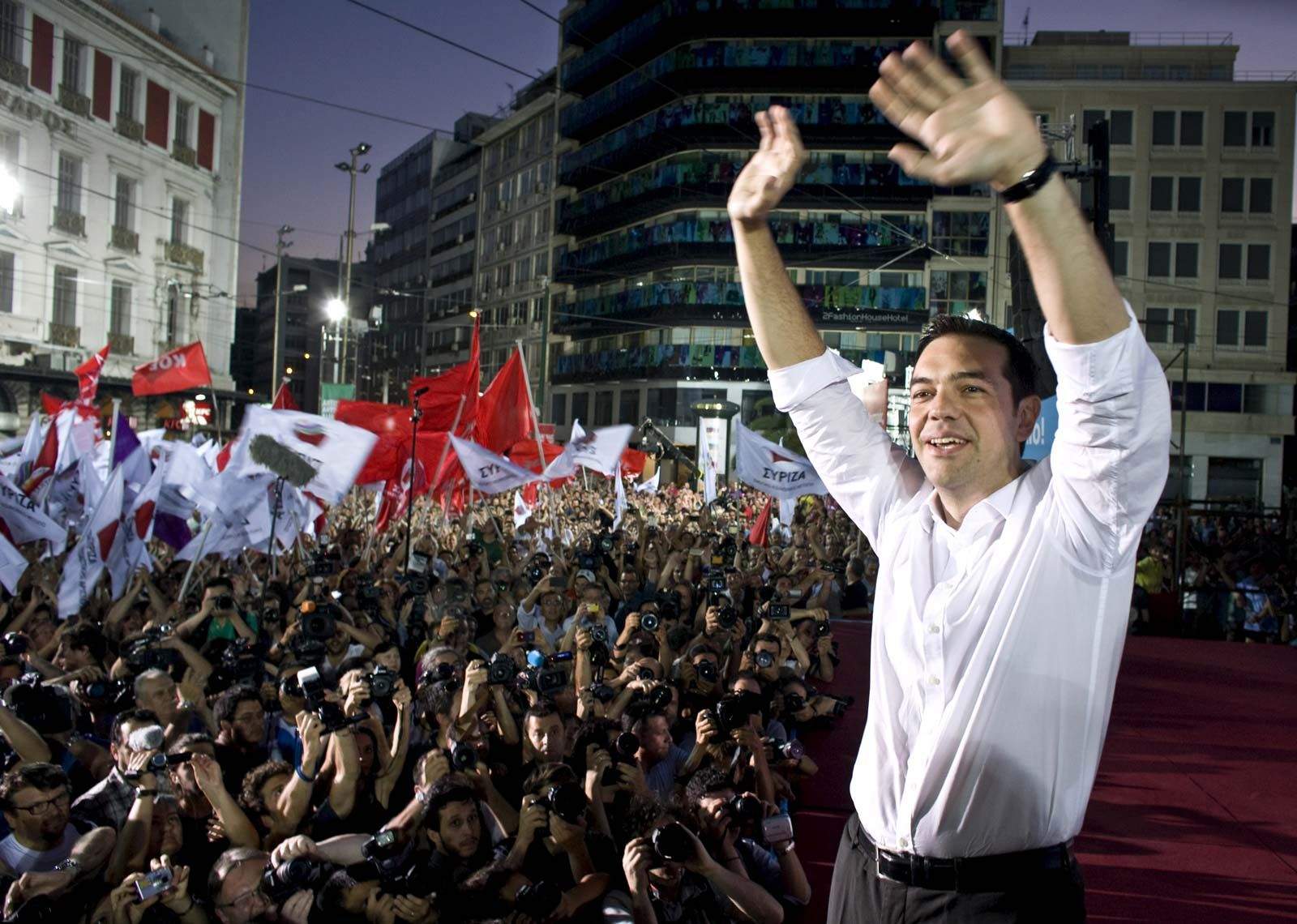
On May 26, 2026, Tsipras marked his political return by launching a new party called ELAS (“Greek Left Alliance”) during a rally in Athens near the Acropolis. Describing the party as a “great progressive alliance,” Tsipras noted that ELAS aimed to unite “social democracy, the radical left, and political ecology” into what he called “the Greek Left Alliance.” During his launch speech, Tsipras cautioned about growing inequalities, rising cost of living, corruption, institutional decline, and other challenges facing democracy in Greece. Tsipras said the new party would emphasize issues such as labor protections, affordable housing, environmental sustainability, digital sovereignty, social welfare, and a multidimensional foreign policy.