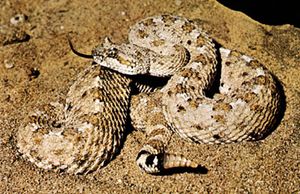
horned viper
Quick Summary
The horned viper, scientifically known as Cerastes cerastes, is a venomous snake belonging to the viper family, Viperidae. This species, along with the common sand viper (C. vipera), inhabits desert regions of North Africa and the Middle East.1
Key characteristics of the horned viper include:
* Appearance: Small (under 60 cm or 2 feet), stocky, and broad-headed, with a pale, sand-colored body marked by dark spots or bars. A distinctive feature is the spinelike scale above each eye, though this is absent in the common sand viper.1
* Behavior: They often bury themselves in sand to ambush prey like lizards and small mammals, and to escape the heat. They move using a sidewinding motion across the sand.1
* Venom: Their venom is relatively weak and rarely fatal to humans.1
Vipers, in general, are characterized by long, hollow fangs that fold back when not in use, vertical pupils, and keeled scales.2
Ask Britannica AI about this topic
Britannica doesn't have a full article on this topic, so we've curated a list of our relevant coverage.