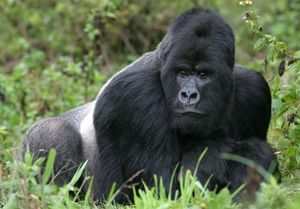
eastern gorilla
Quick Summary
The eastern gorilla (Gorilla beringei) is one of two species of gorillas and is the largest living primate. They inhabit the tropical forests of equatorial Africa and are closely related to humans, sharing a common ancestor about 10 million years ago.1
There are two subspecies of eastern gorillas:
* Eastern lowland gorilla (G. beringei graueri): Found in the lowland rainforests of the eastern Democratic Republic of the Congo.1
* Mountain gorilla (G. beringei beringei): Lives in the montane rainforests and bamboo forests of the highland terrain near the borders of Uganda, Rwanda, and the Democratic Republic of the Congo.1
Eastern gorillas are robust with black skin and hair. Adult males, known as silverbacks, develop a distinctive saddle of gray or silver hairs on their backs. They live in stable family groups led by one or more silverbacks and are diurnal and primarily terrestrial, using knuckle-walking for locomotion. Their diet is vegetarian, with eastern gorillas consuming leaves, stalks, and shoots.1
Both eastern gorilla subspecies are listed as critically endangered by the International Union for Conservation of Nature (IUCN), with fewer than 5,000 individuals remaining in total. Threats include habitat loss and hunting.1
Ask Britannica AI about this topic
Britannica doesn't have a full article on this topic, so we've curated a list of our relevant coverage.