





- Also called:
- greater bilby, dalgyte, or greater rabbit-eared bandicoot
- Related Topics:
- Macrotis

bilby
-
What is a bilby?
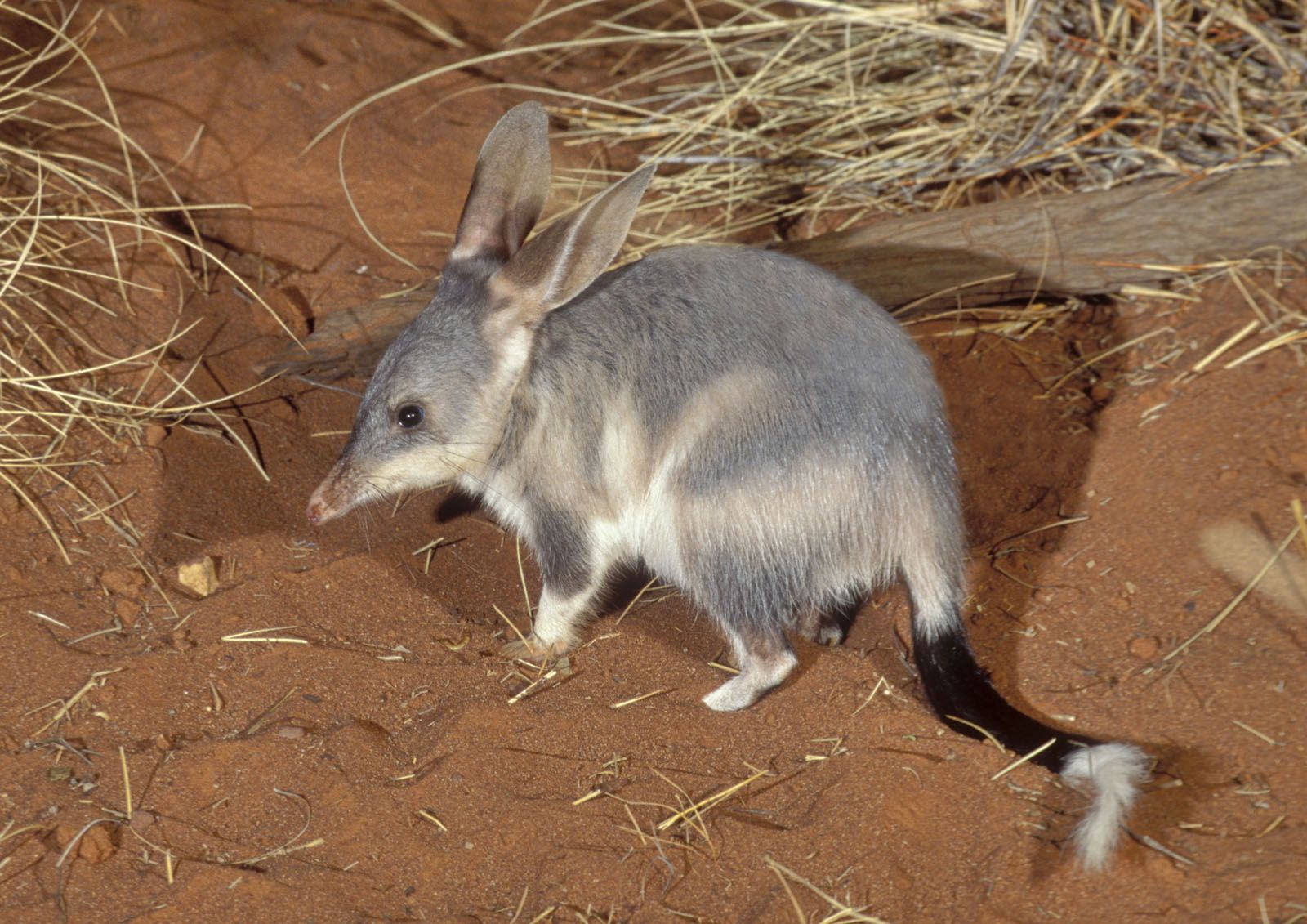
The bilby (Macrotis lagotis) is a nocturnal, burrowing marsupial with long ears, native to Australia and classified in the family Thylacomyidae. Bilbies have blue-gray fur, a white underbelly, and a tail with a band of black fur ending in a white tuft.
They are sexually dimorphic, with males growing up to 55 cm in length and weighing around 2.5 kg, nearly twice the size of females. Once occupying over 70% of Australia, they are now limited to the deserts of northwestern Australia and a small area of southwestern Queensland. Habitat loss and invasive species have led to a decline in bilby populations, leading to their classification as a vulnerable species with fewer than 10,000 remaining in the wild. They face threats from native predators, such as eagles and pythons, and invasive species like foxes and cats.
1 Britannica SourceCreated from Britannica articles using AI. AI can make mistakes, so verify using Britannica articles. -
Where do bilbies live?
Bilbies are native to Australia and are now mostly found in the Great Sandy, Tanami, and Gibson deserts in northwestern Australia, as well as in a small part of southwestern Queensland. They are closely related to bandicoots.
Since the 1800s, their population has declined due to habitat loss and invasive predators. Reintroduction programs have been established in New South Wales, Southern Australia, and other regions. Fewer than 10,000 bilbies are estimated to remain in the wild.
Bilbies are omnivores, eating seeds, bulbs, fruits, insects, worms, and small animals. Native predators include wedge-tailed eagles, carpet pythons, and monitor lizards, but invasive species like red foxes, feral cats, and dingoes cause the most deaths.
1 Britannica SourceCreated from Britannica articles using AI. AI can make mistakes, so verify using Britannica articles. -
What do bilbies eat?
Bilbies are omnivorous marsupials with a varied diet. They consume seeds from native grasses, plant bulbs, and fruits, and they also hunt insects like termites, worms, and small lizards and mammals.
Bilbies face competition for food from invasive species such as the European rabbit. They are also preyed upon by native predators, including wedge-tailed eagles, carpet pythons, and monitor lizards. However, invasive species like red foxes, feral cats, and dingoes cause the majority of bilby deaths.
2 Britannica SourcesCreated from Britannica articles using AI. AI can make mistakes, so verify using Britannica articles. -
Why are bilbies considered marsupials?
Bilbies are considered marsupials because they are mammals characterized by premature birth. After a short gestation, the underdeveloped young, called joeys, continue to develop while attached to the nipples in the mother's marsupium (pouch).
The opening to the pouch faces backward to prevent excavated material from entering while burrowing. After 75–80 days in the pouch, joeys remain in the burrow for about 14 days before living independently. Female bilbies can reproduce at five months, and males at eight months.
Bilbies are native to Australia and belong to the family Thylacomyidae. They have a long snout, blue-gray fur, a white underbelly, and long, hairless ears.
2 Britannica SourcesCreated from Britannica articles using AI. AI can make mistakes, so verify using Britannica articles. -
How do bilbies care for their young?
Bilbies are solitary, but they construct burrows that serve as nurseries for their young. They can breed year-round and may have up to four litters annually. After a gestation of only 12–14 days, the joeys (usually one or two) climb into their mother’s pouch, where they suckle milk and continue to develop for 75–80 days.
After leaving the pouch, the young remain in the burrow for about two weeks before either leaving on their own or being expelled by their mother. Female bilbies can reproduce at five months, while males reach sexual maturity at eight months.
2 Britannica SourcesCreated from Britannica articles using AI. AI can make mistakes, so verify using Britannica articles. -
Why are bilbies endangered and what is being done to protect them?
Bilby populations have declined since the 1800s due to habitat loss and increased predation from invasive species. Today, they inhabit only a fraction of their original range in Australia. The International Union for Conservation of Nature (IUCN) initially classified bilbies as endangered but has since upgraded their status to vulnerable. Reintroduction programs have been established to create sustainable bilby populations in New South Wales, Southern Australia, Western Australia, and Queensland. There are possibly fewer than 10,000 bilbies in the wild. The Foundation for Rabbit-Free Australia Inc. has also campaigned to replace the Easter bunny with the Easter bilby to raise awareness about bilby conservation and the ecological damage caused by rabbits.
1 Britannica SourceCreated from Britannica articles using AI. AI can make mistakes, so verify using Britannica articles.
bilby, (Macrotis lagotis), small, burrowing, nocturnal, long-eared marsupial belonging to the family Thylacomyidae (order Peramelemorphia) and native to Australia. Prior to the arrival of Europeans, bilbies occupied habitats across more than 70 percent of Australia. At present, however, they are restricted to the Great Sandy, Tanami, and Gibson deserts in northwestern Australia and a small pocket of southwestern Queensland. Bilbies are closely related to bandicoots, which are classified in the family Peramelidae.
Physical features
The bilby is known for its long snout, blue-gray fur, white underbelly, and long, hairless ears that resemble those of rabbits. On its tail is a prominent band of black fur that terminates with a white tuft that surrounds a naked, spurlike tip. The species is sexually dimorphic, males being nearly twice as large as females; the largest males grow to 55 cm (about 22 inches) in length and weigh approximately 2.5 kg (about 5.5 pounds). The ends of the forelimbs terminate in five digits with the middle three digits possessing a claw. The hind limbs are similar in structure to those of kangaroos; however, instead of hopping, bilbies lope in a manner similar to that of hares. The opening to the marsupium (pouch) in females faces backward (that is, the pouch opening is located lower on the abdomen than the pouch itself) to prevent material excavated by burrowing activities from entering the cavity.
Predators and prey
Bilbies are omnivorous. In addition to consuming the seeds of native grasses, plant bulbs, and fruits, bilbies prey upon insects (such as termites), worms, and small lizards and mammals.


 " height="20" alt="HEW Logo">

Native predators, such as wedge-tailed eagles (Aquila audax), carpet pythons (Morelia spilota), and monitor lizards (family Varanidae), kill many bilbies each year. However, invasive species, such as red foxes, feral cats, and dingoes, are responsible for the bulk of bilby mortality.
Nesting and reproduction

Bilbies are solitary animals, and members of both sexes construct several burrows within their home range as hiding spots from daytime heat or from predators. These burrows also serve as nurseries for young.
Bilbies are capable of breeding year-round and have one of the shortest mammalian gestation periods; females may have up to four litters within a single year. Approximately 12–14 days after breeding, females give birth to one or two (occasionally three or four) offspring, or joeys, who subsequently climb into the mother’s marsupium. The joeys complete their development over the next 75–80 days inside the pouch, where they suckle milk from their mother. After they leave the pouch, they remain in their mother’s burrow for approximately 14 days and then finally either leave to live on their own or are forcibly expelled by their mother. Female bilbies are capable of reproducing at five months of age, and males become sexually mature at eight months.
Bilby longevity in the wild is a matter of some debate. In captivity, however, bilbies may live up to 11 years, but most live only six to seven years.
The trusted destination for professionals, college students, and lifelong learners.
SUBSCRIBE


Conservation status
Since the 1800s, habitat loss from land-use conversion and increased predation and competition stemming from species invasions have caused bilby populations to decline. (These forces also caused the extinction of the only other known species in the genus Macrotis—M. leucura, a smaller form commonly called the lesser bilby—sometime between 1931 and 1960.) Between 1982 and 1994 the International Union for Conservation of Nature (IUCN) classified the bilby as an endangered species on its Red List of Threatened Species. Since 1994, however, the IUCN has upgraded the animal’s status to vulnerable. Although reintroduction programs designed to create sustainable bilby populations in other parts of Australia have been established in New South Wales and Southern Australia, as well as several parts of Western Australia and Queensland, possibly fewer than 10,000 bilbies remain in the wild.
The bilby and the European rabbit (Oryctolagus cuniculus), an invasive species that has become an agricultural pest in Australia, are known to compete with one another for food. In 1991 members of the organization Foundation for Rabbit-Free Australia Inc. started a campaign to replace the “Easter bunny” in Australia with the “Easter bilby” to raise public awareness of bilby conservation while also educating the Australian public about the ecological damage caused by introduced rabbits.