
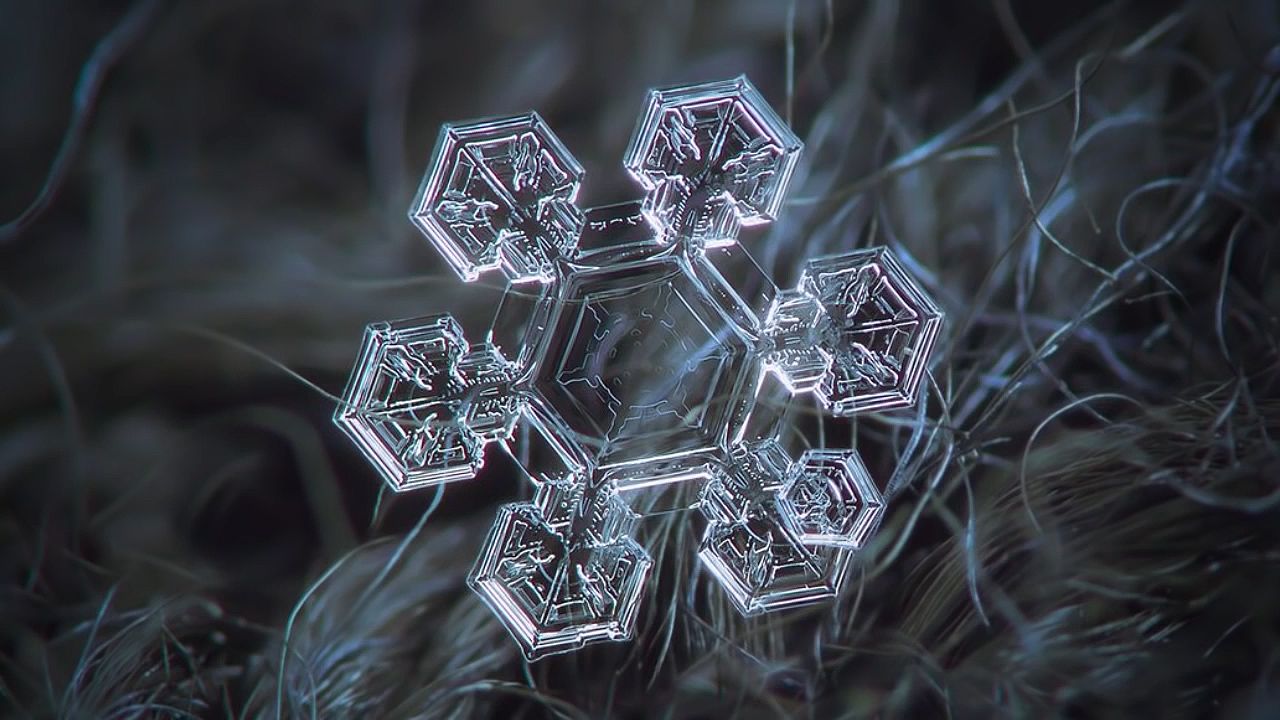
How Do Snowflakes Form?
A snowflake starts as a dust grain floating in a cloud.
© American Chemical Society (A Britannica Publishing Partner)
-
Contunico © ZDF Studios GmbH, MainzOverview of savory.
-
Encyclopædia Britannica, Inc.Two people making change for five dollars as a representation of how matter is conserved in a chemical reaction.
-
Science in Seconds (www.scienceinseconds.com) (A Britannica Publishing Partner)Ecological effects of light pollution.
-
© American Chemical Society (A Britannica Publishing Partner)Meet nature's simplest hydrogen bond crystal.
-
© MinutePhysics (A Britannica Publishing Partner)Magnetic fields and the levels of magnetism of particles, atoms, crystals, and domains.
-
Contunico © ZDF Studios GmbH, MainzLearn why snow makes a crunching sound when underfoot.
-
Contunico © ZDF Studios GmbH, MainzOverview of avalanches.


News •
See where El Niño may help deliver lots of snow this winter
• Nov. 11, 2026, 1:00 PM ET (Washington Post)
Parts of the Pittsburgh area could see snow this weekend, but most will see a wintry mix or rain
• Nov. 10, 2026, 7:59 AM ET (CBS)
Snow could return to New York this week. When and where it's possible
• Nov. 9, 2026, 9:58 AM ET (Rochester Democrat and Chronicle)
Untangling the patterns of the cosmic microwave background to better understand the early universe
• Nov. 6, 2026, 7:20 PM ET (Phys.org)
Snow in the forecast for El Paso, Teller counties Wednesday
• Nov. 4, 2026, 3:00 AM ET (The Colorado Springs Gazette)
Transcript
Chemistry is in everything, including snow. Crystallography allows us to study the arrangement of atoms in a snowflake crystal. Though they all start pretty much the same, once they begin crystallizing, it's true that no two snowflakes are alike. In fact, the number of possible shapes is staggering.
A snowflake starts as a dust grain floating in a cloud. Water vapor in the air sticks to the dust grain, and the resulting droplet turns directly into ice. Crystal faces appear on the frozen droplet, then a prism forms with six faces and a top and bottom. A cavity forms in each prism face because ice grows fastest near the edges.
Faster growth on the corners causes six branches to sprout. The lines in each branch are due to ridges and grooves on the surface. These six branches form the corners of a hexagon, which occurs because the water molecules chemically bond into a hexagonal network.
When the temperature cools to minus 13 Celsius, new growth at the branch tips narrows. At minus 14, side branches sprout on each branch. Suddenly, the crystal encounters a quick blast of warmer air followed by cooler air, and more side branches sprout. The crystal gradually warms, making the tips long and narrow. The crystal encounters even warmer air, which slows the growth and widens the tips. Finally, this unique and delicate structure falls to the earth along with countless other snowflakes.
Cool, right? Over the years crystallographers have been classifying snow crystals into different categories based on their arrangement of atoms. In the 1930s there were 21 different classifications of snowflake, but by 2013, that number soared to 121. To see snow crystals at the molecular level, scientists send a beam of X-rays through a sample of snowflakes. The X-rays bounce off all the atoms in a snowflake and head in all different directions, sort of like the light off the sides of a disco ball. By seeing where these beams end up, we can figure out the arrangement of the snowflake's atoms, and therefore what it looks like at the atomic level.
Who's to say what new snowflake categories crystallographers will find in 2016. But one thing's for certain, the ever-changing environment means that snowflakes can have a mind-boggling array of shapes.
Last Modification: