
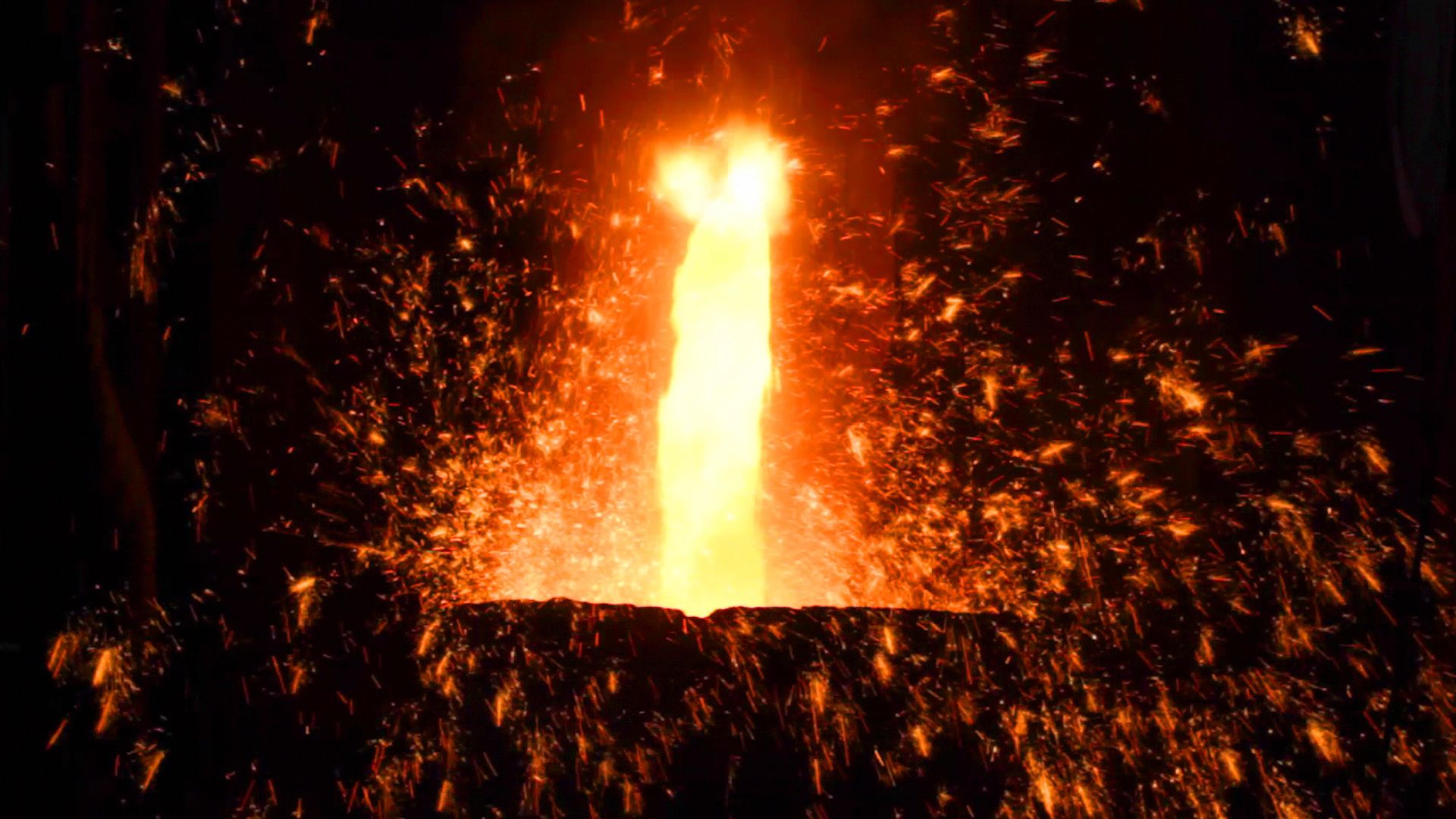
How iron is turned into steel
Iron ore is one of the most abundant elements on Earth, and one of its primary uses is in the production of steel. When combined with carbon, iron changes character completely and becomes the alloy steel.
Encyclopædia Britannica, Inc.
-
Contunico © ZDF Studios GmbH, MainzA 2009 profile of Son Masayoshi as SoftBank began to expand beyond Japan.
-
Encyclopædia Britannica, Inc.Dairy farming in Denmark.
-
© American Chemical Society (A Britannica Publishing Partner)Learn about the development and applications of glass paint, which is made of silica glass and formulated to reflect sunlight, protecting surfaces from heat and damage.
-
© American Chemical Society (A Britannica Publishing Partner)Learn why carbon monoxide is dangerous and how to prevent poisoning.
-
Great Museums Television (A Britannica Publishing Partner)A discussion of the competition among collectors and museums for dinosaur bones, including those of Sue, from the documentary The Dinosaur Wars.
-
© American Chemical Society (A Britannica Publishing Partner)Learn about carbon and how it forms the basis of life.
-
© American Chemical Society (A Britannica Publishing Partner)Learn about some possible applications of graphene, a uniquely strong, flexible, and thin carbon-based material.




News •
Fully automated testing of bulk metals paves the way for AI-driven materials development
• Oct. 16, 2026, 10:20 AM ET (Phys.org)
Transcript
NARRATOR: An important use of iron ore is the production of steel. Iron alone is too soft to be of structural value, but, when combined with less than 2 percent carbon at a very high temperature, it creates the alloy steel.
Steel is a strong, hard material with valuable mechanical properties. It is the most widely used structural metal in the world. Steel owes its diverse properties to the changeable crystalline structure of iron at different temperatures. As iron cools below the melting temperature of 1,538 degrees Celsius, its atoms align themselves in a compact structure. In this form iron is known as ferrite. When iron cools below 1,394 degrees Celsius, it is known as austenite and its structure changes.
In the gaps between the iron atoms, austenite can retain more carbon than ferrite can. And the more carbon in the structure, the harder the resulting steel.
Last Modification: