
Britannica
Sources used in this answer
Why is the direct ancestry between Ardipithecus ramidus and Australopithecus uncertain?
Created from Britannica articles
using AI.
AI can make mistakes, so verify using Britannica articles.
Ardipithecus
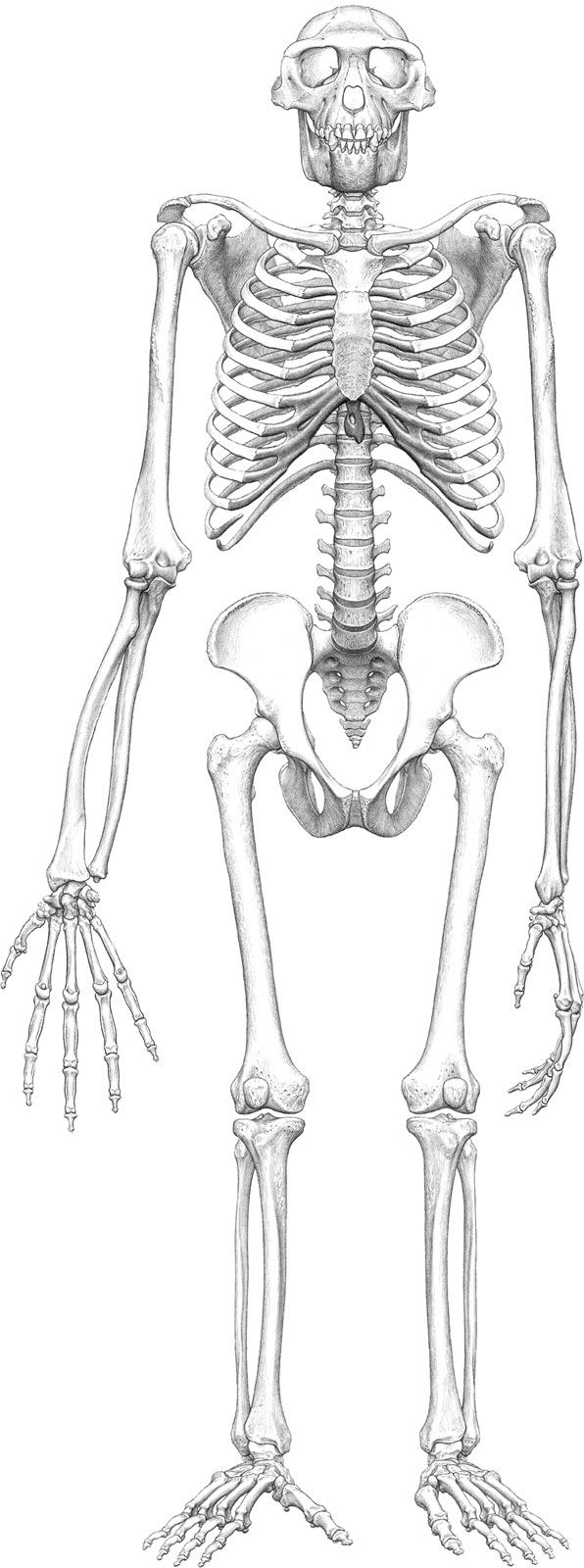
Reconstructed frontal view of the skeleton of “Ardi,” a specimen belonging to the early hominid species Ardipithecus ramidus.
The uncertainty regarding whether Ardipithecus ramidus is the direct ancestor of Australopithecus stems primarily from limitations in the fossil record and the rapid pace of early hominin evolution.12
Key factors contributing to this uncertainty include:
- Insufficient Fossil Samples: The rarity of associated skeletal remains makes it difficult to determine the precise rate of early hominin evolution or to confirm specific lineage transitions.12
- Temporal Gaps: While the discovery of Au. anamensis helped bridge the gap between Ar. ramidus and later australopiths, some paleontologists argue that the 200,000-year interval between the youngest Ar. ramidus fossils (4.4 million years ago) and the oldest Australopithecus remains (4.2 million years ago) is too short for a direct evolutionary transition.1
- Persistence of Species: The discovery of primitive, Ardipithecus-like foot fossils in 3.4-million-year-old sediments suggests that members of the genus Ardipithecus may have persisted in the Afar region long after Australopithecus had already appeared.1
Consequently, it remains impossible to determine if Ar. ramidus was a direct ancestor or a relict of an earlier species that eventually gave rise to Australopithecus.1