
Britannica
Sources used in this answer
Why do very thin ceramic disk capacitors become fragile?
Created from Britannica articles
using AI.
AI can make mistakes, so verify using Britannica articles.
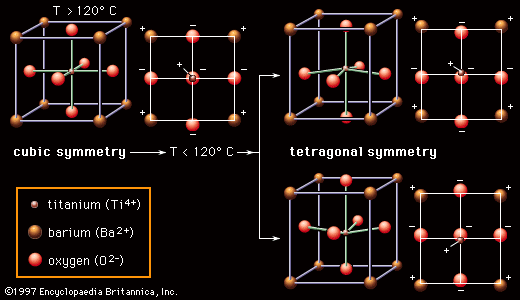
capacitor dielectric and piezoelectric ceramics
Figure 1: Ferroelectric properties of barium titanate (BaTiO3). (Left) Above 120° C the structure of the BaTiO3 crystal is cubic, and there is no net polarization of charge; (right) below 120° C the structure changes to tetragonal, shifting the relative positions of the ions and causing a concentration of positive and negative charges toward opposite ends of the crystal.
Very thin ceramic disk capacitors become fragile because of the physical limitations inherent in their design. While reducing the thickness of the ceramic disk is a method used to increase the device's capacitance, this process compromises the structural integrity of the material, making it prone to breakage.1
To address the limitations of these fragile disks, the industry has largely shifted toward multilayer capacitors (MLCs). These devices achieve high capacitance by interleaving thin dielectric and electrode layers, which provides a more robust and reliable alternative for modern electronic circuitry.1