
Why do randomly oriented domains cancel the overall polarization of a ceramic?
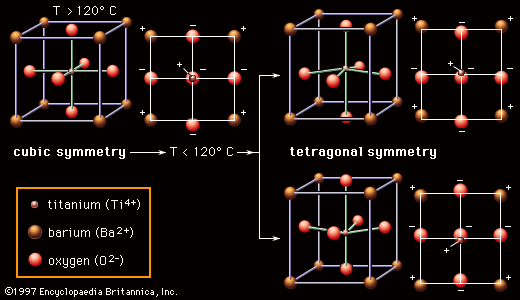
In a polycrystalline piezoelectric ceramic, the material is composed of many individual grains, each containing domains where the dipoles are aligned in a specific direction. When the ceramic is in its initial, unpoled state, these domains are oriented randomly throughout the material. Because these domains point in various, opposing directions, their individual electric dipole moments effectively cancel each other out, resulting in no net macroscopic polarization for the ceramic as a whole.1
To utilize the piezoelectric properties of these materials, they must undergo a process called poling. During this process, the ceramic is cooled through its Curie point while subjected to a strong external electric field. This field exerts a torque on the domains, forcing them to align along a desired axis. Once the field is removed, the domains remain largely aligned, providing the ceramic with a net polarization that allows it to exhibit piezoelectric effects.1