
Why did alternating-current systems become more useful than direct-current systems for long-distance transmission?
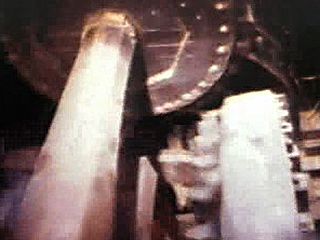
The ingenuity people used in harnessing waterpower can be seen in this medieval-style mill. The waterwheel is turned by a stream and is connected to a shaft that leads into the building. At the other end of the shaft is a gear. The connection of a series of gears translates the power from the stream to a shaft that drives a millstone, which grinds flour from grain.
(30 sec; 1.84MB)
Alternating-current (AC) systems became more useful than early direct-current (DC) systems for long-distance transmission primarily because of the difficulty in changing voltages with 19th-century DC technology.1
In power transmission, energy loss due to resistive heating is proportional to the square of the current. To minimize this loss over long distances, it is necessary to transmit power at very high voltages and correspondingly low currents. AC systems gained a decisive advantage because they can easily use transformers to step up voltage for efficient transmission and step it down for safe domestic or commercial use.12
Early DC grids, by contrast, were limited to low voltages, which necessitated high currents and resulted in significant energy loss, restricting their range to short distances. While modern technology has since enabled high-voltage direct current (HVDC) transmission, AC systems were the standard that supplanted early DC grids due to the simplicity and efficiency of voltage transformation.13