
Why can only crystal structures without a centre of symmetry be piezoelectric?
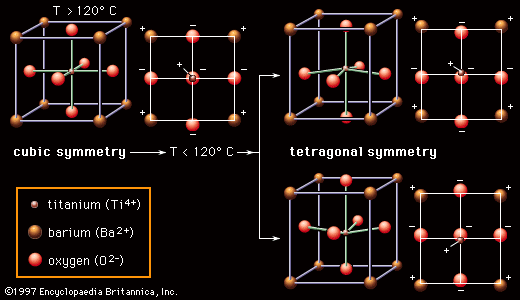
Piezoelectricity occurs due to the relative displacement of ions within a crystal lattice when the material is subjected to mechanical stress.12
For a material to exhibit this effect, its crystal structure must lack a centre of symmetry—also known as an inversion centre. A centre of symmetry is a point within the crystal from which the structure is identical in any two opposite directions. If a crystal possesses this symmetry, the displacement of ions caused by stress in one direction is effectively cancelled out by the symmetry of the lattice, preventing the development of a net electric polarization.21
In materials like barium titanate, this symmetry is lost during a structural transition (such as from cubic to tetragonal), which shifts ions away from their central positions and allows for the generation of a voltage under stress.2