
Britannica
Sources used in this answer
Why can making a ceramic disk capacitor thinner increase its capacitance?
Created from Britannica articles
using AI.
AI can make mistakes, so verify using Britannica articles.
capacitor dielectric and piezoelectric ceramics
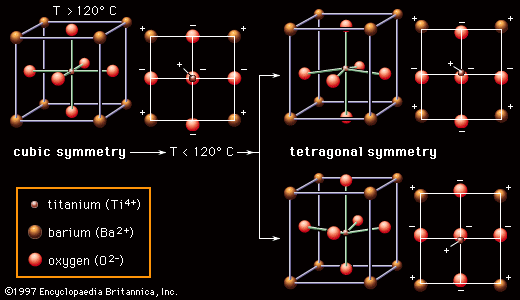
Figure 1: Ferroelectric properties of barium titanate (BaTiO3). (Left) Above 120° C the structure of the BaTiO3 crystal is cubic, and there is no net polarization of charge; (right) below 120° C the structure changes to tetragonal, shifting the relative positions of the ions and causing a concentration of positive and negative charges toward opposite ends of the crystal.
Making a ceramic disk capacitor thinner increases its capacitance because capacitance is inversely proportional to the distance between the capacitor's electrodes.12
For a parallel-plate capacitor, the capacity () is defined by the formula:
In this equation, represents the separation distance between the electrodes (the thickness of the dielectric material). As the thickness () is reduced, the value of the capacitance () increases. While thinning a ceramic disk is an effective way to boost capacitance, it can also make the component more fragile, which is why manufacturers often utilize multilayer capacitors to achieve higher capacitance in a more robust form factor.123