
Britannica
Sources used in this answer
Why can barrier-layer capacitors experience dielectric breakdown?
Created from Britannica articles
using AI.
AI can make mistakes, so verify using Britannica articles.
capacitor dielectric and piezoelectric ceramics
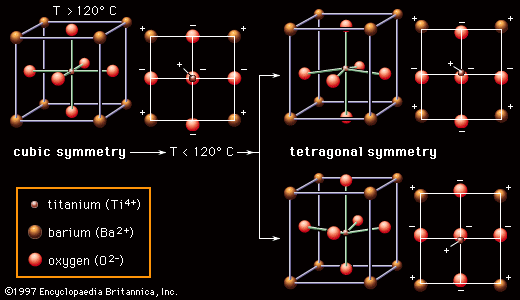
Figure 1: Ferroelectric properties of barium titanate (BaTiO3). (Left) Above 120° C the structure of the BaTiO3 crystal is cubic, and there is no net polarization of charge; (right) below 120° C the structure changes to tetragonal, shifting the relative positions of the ions and causing a concentration of positive and negative charges toward opposite ends of the crystal.
Barrier-layer (BL) capacitors can experience dielectric breakdown because the resistive barriers formed at the surface or grain boundaries are extremely thin. This thinness causes the local electric fields within the material to become very intense.1
When dielectric breakdown occurs, it results in a sudden failure of the material and a catastrophic discharge through the dielectric, which typically causes irreversible damage to the ceramic. Consequently, while these capacitors are valued for their very high apparent dielectric constants, they must be used with caution due to their low dielectric breakdown strengths.1