
- capacitor dielectric and piezoelectric ceramics - Ferroelectric properties of barium titanate
- capacitor dielectric and piezoelectric ceramics - Piezoelectric ceramics
- dielectric constant
- electrostatics - Dielectrics, polarization, and electric dipole moment
- capacitor dielectric and piezoelectric ceramics - Random-access memories
Why can a peak in dielectric constant near the Curie point be a problem for capacitors?
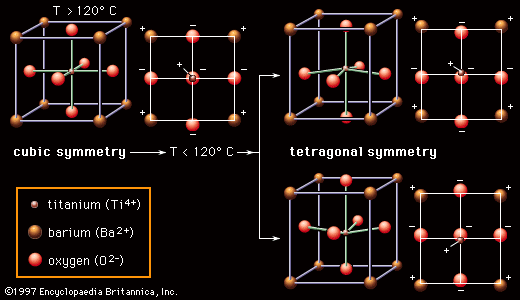
A peak in the dielectric constant near the Curie point is considered problematic for capacitors because it results in a lack of stability in the material's performance.1
In ferroelectric materials like barium titanate, the dielectric constant—which measures a material's ability to store electric charge—exhibits a large, sharp increase at the temperature where the material transitions from a tetragonal to a cubic crystal structure. Because the dielectric constant is highly sensitive to temperature changes near this point, the capacitance of the device becomes unstable, making it unsuitable for applications requiring consistent performance across varying temperatures.1
To mitigate this issue, engineers use chemical substitutions to modify the material's properties:
* Lead (Pb²⁺) is substituted to increase the Curie point.1
* Strontium (Sr²⁺) is substituted to lower the Curie point.1
* Calcium (Ca²⁺) is substituted to broaden the temperature range over which the peak occurs, thereby improving overall stability.1