
Britannica
Sources used in this answer
Why are palladium and palladium-silver alloys used as electrodes in multilayer ceramic capacitors?
Created from Britannica articles
using AI.
AI can make mistakes, so verify using Britannica articles.
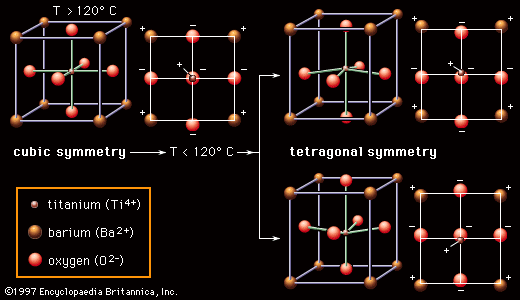
capacitor dielectric and piezoelectric ceramics
Figure 1: Ferroelectric properties of barium titanate (BaTiO3). (Left) Above 120° C the structure of the BaTiO3 crystal is cubic, and there is no net polarization of charge; (right) below 120° C the structure changes to tetragonal, shifting the relative positions of the ions and causing a concentration of positive and negative charges toward opposite ends of the crystal.
Palladium and palladium-silver alloys are used as electrodes in multilayer ceramic capacitors (MLCs) primarily because of their high melting point.1
In the manufacturing of MLCs, dielectric and electrode layers are interleaved and then fired together in a process known as cofiring. Because these metals possess a melting point higher than the sintering temperature required for the ceramic dielectric, they remain stable and intact during the high-temperature firing process. This compatibility allows the electrode material to withstand the heat necessary to form the capacitor's structure without melting or degrading, ensuring the integrity of the internal electrical connections.1