
Britannica
Sources used in this answer
Why are liquid-mix techniques used to prepare barium titanate powders?
Created from Britannica articles
using AI.
AI can make mistakes, so verify using Britannica articles.
capacitor dielectric and piezoelectric ceramics
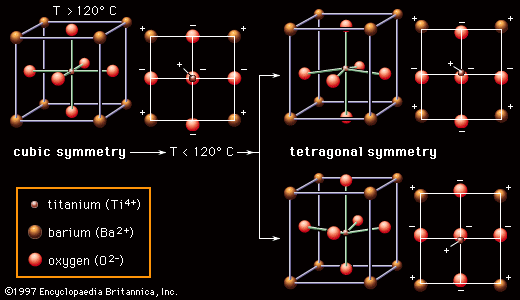
Figure 1: Ferroelectric properties of barium titanate (BaTiO3). (Left) Above 120° C the structure of the BaTiO3 crystal is cubic, and there is no net polarization of charge; (right) below 120° C the structure changes to tetragonal, shifting the relative positions of the ions and causing a concentration of positive and negative charges toward opposite ends of the crystal.
Liquid-mix techniques are employed in the preparation of barium titanate powders to achieve several critical improvements over traditional solid-state processing methods. These techniques are primarily used to ensure:
- Better mixing: They facilitate superior blending of components, often down to the atomic level, which is essential for achieving chemical homogeneity throughout the material.12
- Precise control: They allow for more accurate regulation of the barium-to-titanium ratio.2
- High purity: They help maintain high levels of material purity, which is vital for electroceramic applications.12
- Small particle size: These methods assist in producing active powders with submicrometre grain sizes, which increases the surface area-to-mass ratio and enhances the driving force for sintering.12
By utilizing these chemical approaches, manufacturers can overcome the limitations of standard solid-state techniques, which typically require numerous grinding and firing steps to approach a uniform composition.1