
- capacitor dielectric and piezoelectric ceramics - Piezoelectric ceramics
- capacitor dielectric and piezoelectric ceramics - Ferroelectric properties of barium titanate
- capacitor dielectric and piezoelectric ceramics
- ceramic composition and properties - Crystal structure
- electroceramics
- ceramic composition and properties
- electronic substrate and package ceramics
Why are ceramic materials useful as dielectrics in capacitors?
Ceramic materials are highly effective as dielectrics in capacitors primarily due to their poor electrical conductivity, which is a result of strong ionic and covalent bonds that prevent electrons from moving freely through the material when subjected to an electric field.12
When used in a capacitor, these materials become electrically polarized, meaning their internal positive and negative charges separate and align with the applied field. This polarization reduces the strength of the electric field between the electrodes, which significantly increases the amount of electric charge the device can store.1
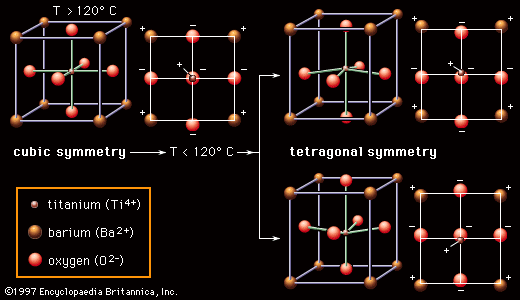
Many ceramic capacitors utilize perovskite compounds, such as barium titanate, which are prized for their ferroelectric properties. In these materials, the crystal structure allows for spontaneous polarization, leading to exceptionally high dielectric constants—the measure of a material's ability to store energy. By applying an electric field, the boundaries between polarized domains within the ceramic can shift, producing large net polarizations that maximize the capacitor's storage capacity.13