
Britannica
Sources used in this answer
- capacitor dielectric and piezoelectric ceramics - Disk, multilayer, and tubular capacitors
- electricity - Capacitors in series and parallel
- capacitor dielectric and piezoelectric ceramics - Piezoelectric ceramics
- capacitor dielectric and piezoelectric ceramics - Barrier-layer capacitors
- capacitor dielectric and piezoelectric ceramics
Why are alternate layers connected in parallel in a multilayer ceramic capacitor?
Created from Britannica articles
using AI.
AI can make mistakes, so verify using Britannica articles.
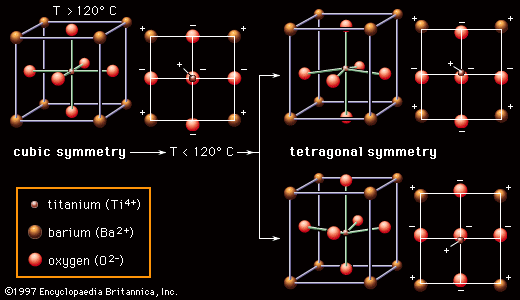
capacitor dielectric and piezoelectric ceramics
Figure 1: Ferroelectric properties of barium titanate (BaTiO3). (Left) Above 120° C the structure of the BaTiO3 crystal is cubic, and there is no net polarization of charge; (right) below 120° C the structure changes to tetragonal, shifting the relative positions of the ions and causing a concentration of positive and negative charges toward opposite ends of the crystal.
In a multilayer capacitor, alternate layers are connected in parallel to realize large capacitances within a compact device.1
By interleaving multiple dielectric and electrode layers, the design effectively stacks many individual capacitors into a single monolithic unit. Because the effective capacitance of capacitors connected in parallel is the sum of the individual capacitances (), this configuration allows for a significant increase in total energy storage capacity compared to a single-layer design, without requiring an increase in the physical footprint of the component.12