
Britannica
Sources used in this answer
Which materials have higher dielectric constants than air and fused quartz?
Created from Britannica articles
using AI.
AI can make mistakes, so verify using Britannica articles.
capacitor dielectric and piezoelectric ceramics
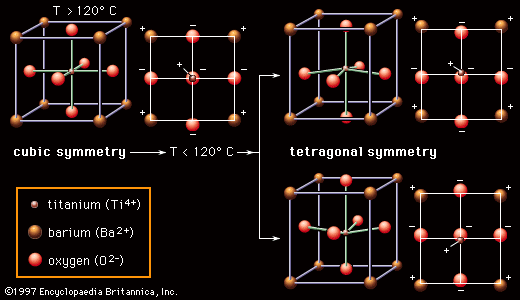
Figure 1: Ferroelectric properties of barium titanate (BaTiO3). (Left) Above 120° C the structure of the BaTiO3 crystal is cubic, and there is no net polarization of charge; (right) below 120° C the structure changes to tetragonal, shifting the relative positions of the ions and causing a concentration of positive and negative charges toward opposite ends of the crystal.
Perovskite ceramics, particularly those based on barium titanate (BaTiO), possess significantly higher dielectric constants than air (which is approximately 1.00059) and fused quartz.12
While the dielectric constant of pure barium titanate typically ranges from 1,000 to 5,000, this value can be increased to 50,000 by substituting the titanium ion with zirconium. Furthermore, specialized barrier-layer (BL) capacitors utilize surface or grain-boundary oxidation strategies to achieve even higher apparent dielectric constants, ranging from 50,000 to 100,000. These materials are highly effective as dielectrics because their crystalline structure allows for large net polarizations when subjected to an electric field.13