
Britannica
Sources used in this answer
What happens to the crystal structure of barium titanate below 120 °C?
Created from Britannica articles
using AI.
AI can make mistakes, so verify using Britannica articles.
capacitor dielectric and piezoelectric ceramics
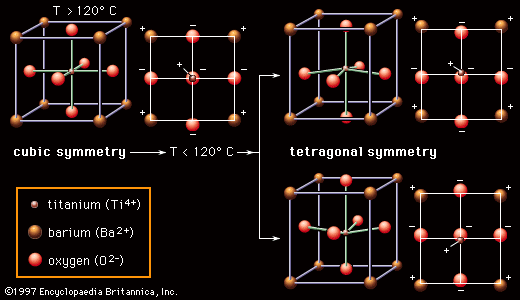
Figure 1: Ferroelectric properties of barium titanate (BaTiO3). (Left) Above 120° C the structure of the BaTiO3 crystal is cubic, and there is no net polarization of charge; (right) below 120° C the structure changes to tetragonal, shifting the relative positions of the ions and causing a concentration of positive and negative charges toward opposite ends of the crystal.
Below 120 °C, barium titanate undergoes a structural transition that changes its symmetry from cubic to tetragonal.1
In this process, the following shifts occur within the crystal structure:
* The barium (Ba²⁺) and oxygen (O²⁻) ions shift from their original cubic positions.1
* The titanium (Ti⁴⁺) ion moves away from the center of the cube.12
This displacement results in a loss of the center of symmetry and creates a permanent electric dipole, where positive and negative charges concentrate toward opposite poles of the vertical axis. This spontaneous polarization, known as ferroelectricity, occurs below the Curie point.12