
Britannica
Sources used in this answer
What are the four main sources of resistance when a ship moves through water?
Created from Britannica articles
using AI.
AI can make mistakes, so verify using Britannica articles.
naval architecture
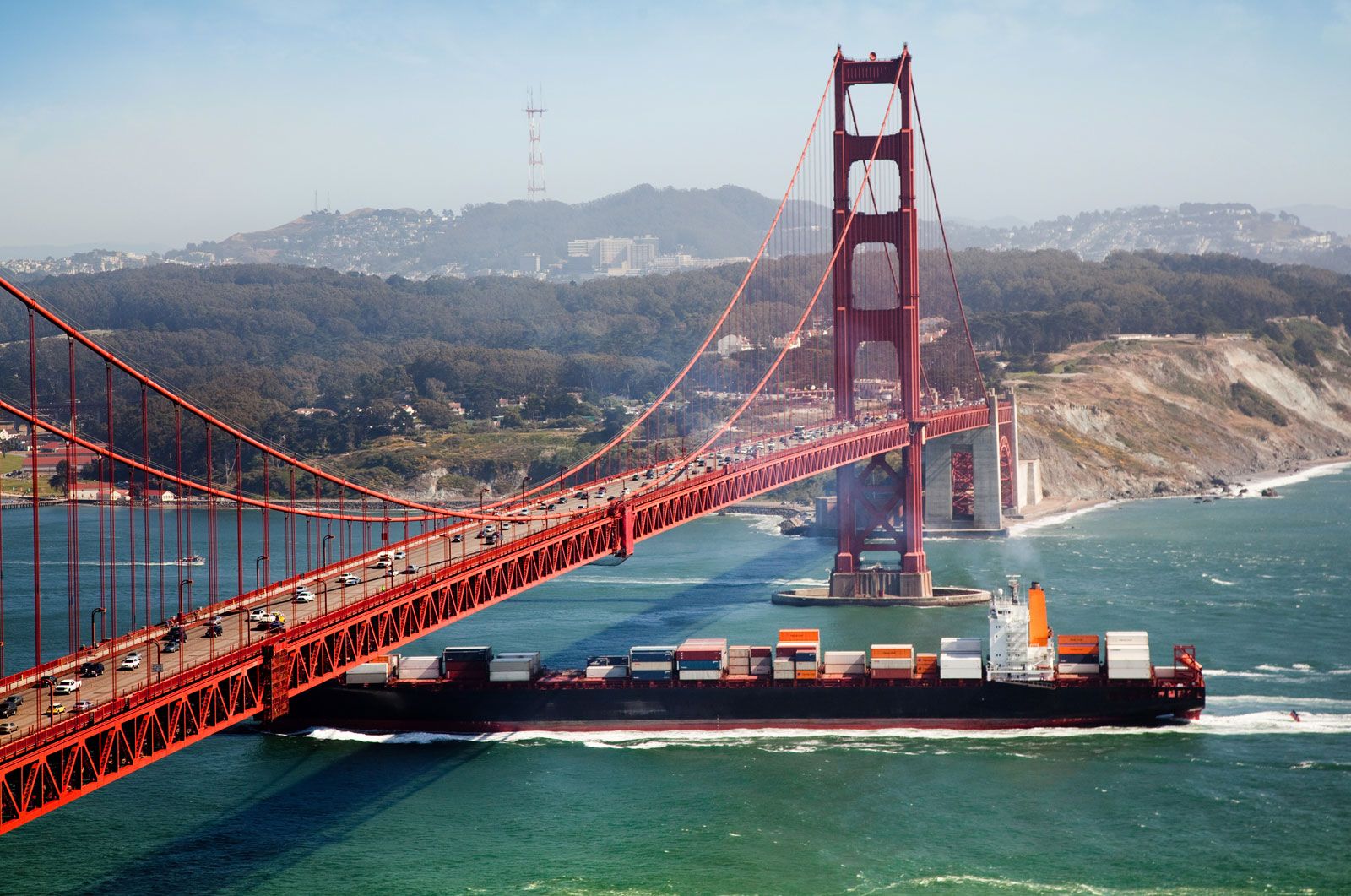
A cargo ship passing the Golden Gate Bridge, near San Francisco.
In the field of naval architecture, the resistance encountered by a ship moving through water at a steady speed is categorized into four primary components:1
- Frictional resistance: This is caused by the friction between the water and the hull surface. As the ship moves, it accelerates water particles, creating a boundary layer of fluid that moves with the vessel. The energy expended to create and maintain this layer is dissipated as heat and cannot be recovered.12
- Wave-making resistance: This results from the energy the ship transfers to the gravity wave system it generates. Because the ship constantly leaves these waves behind, it must continuously expend energy to create new ones.12
- Eddy-making resistance: Also known as separation resistance, this occurs when the water flow fails to follow the hull's contour, particularly at the stern. This creates a zone of eddies and turbulence that exerts a drag force on the ship.123
- Aerodynamic resistance: This is the resistance caused by the air acting upon the parts of the ship that are above the water line.1