
Britannica
Sources used in this answer
How is barium titanate powder made for ceramic capacitors?
Created from Britannica articles
using AI.
AI can make mistakes, so verify using Britannica articles.
capacitor dielectric and piezoelectric ceramics
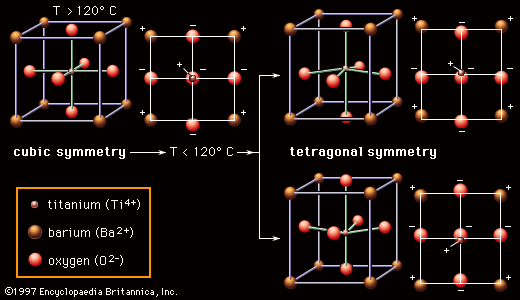
Figure 1: Ferroelectric properties of barium titanate (BaTiO3). (Left) Above 120° C the structure of the BaTiO3 crystal is cubic, and there is no net polarization of charge; (right) below 120° C the structure changes to tetragonal, shifting the relative positions of the ions and causing a concentration of positive and negative charges toward opposite ends of the crystal.
Barium titanate powder, which serves as a primary material for ceramic capacitor dielectrics, is produced through two main methods:
- Mixing and Firing: The traditional approach involves mixing and firing barium carbonate and titanium dioxide.1
- Liquid-Mix Techniques: These methods are increasingly preferred because they allow for better mixing, high purity, submicrometre particle size, and precise control over the barium-to-titanium ratio.1
Once the powder is processed, it is manufactured into capacitors using techniques such as dry-pressing or punching from tape for disk capacitors, or tape casting and doctor blading for multilayer capacitors.1