
How does the Carnot cycle describe the maximum possible efficiency of a heat engine?
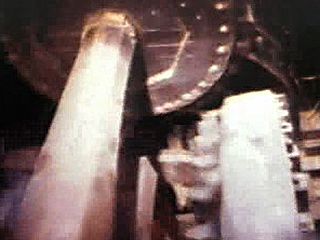
The ingenuity people used in harnessing waterpower can be seen in this medieval-style mill. The waterwheel is turned by a stream and is connected to a shaft that leads into the building. At the other end of the shaft is a gear. The connection of a series of gears translates the power from the stream to a shaft that drives a millstone, which grinds flour from grain.
(30 sec; 1.84MB)
The Carnot cycle is a theoretical model that establishes the absolute upper limit for the efficiency of any heat engine converting thermal energy into work.1
Rather than relying on specific mechanical designs, the cycle demonstrates that maximum efficiency is determined solely by the temperatures of the heat source () and the heat sink (). The maximum possible efficiency () is expressed by the formula:23
This principle dictates that because some heat must always be rejected to a colder reservoir to satisfy the second law of thermodynamics, 100 percent efficiency is physically impossible. Even in a perfectly reversible process where entropy change is zero, a portion of the input energy must be exhausted as waste heat. Consequently, the Carnot cycle serves as a fundamental benchmark, proving that no engine can exceed this efficiency regardless of design improvements or friction reduction.413