
Britannica
Sources used in this answer
How does substituting lead for barium change the Curie point of barium titanate?
Created from Britannica articles
using AI.
AI can make mistakes, so verify using Britannica articles.
capacitor dielectric and piezoelectric ceramics
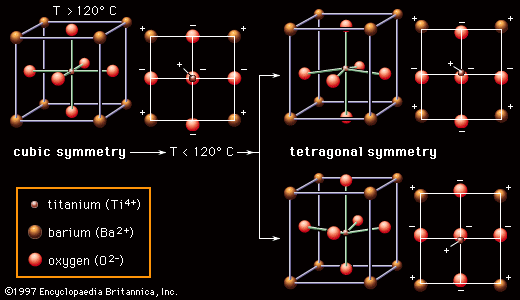
Figure 1: Ferroelectric properties of barium titanate (BaTiO3). (Left) Above 120° C the structure of the BaTiO3 crystal is cubic, and there is no net polarization of charge; (right) below 120° C the structure changes to tetragonal, shifting the relative positions of the ions and causing a concentration of positive and negative charges toward opposite ends of the crystal.
In the context of barium titanate (BaTiO₃) ceramics, substituting lead (Pb²⁺) for barium (Ba²⁺) ions increases the Curie point of the material.1
This type of chemical substitution is often employed to modify the ferroelectric properties of the ceramic, as pure barium titanate exhibits a large peak in its dielectric constant near the Curie point, which can be undesirable for stable capacitor applications.1