
- capacitor dielectric and piezoelectric ceramics - Ferroelectric properties of barium titanate
- capacitor dielectric and piezoelectric ceramics - Piezoelectric ceramics
- capacitor dielectric and piezoelectric ceramics
- capacitor dielectric and piezoelectric ceramics - Disk, multilayer, and tubular capacitors
- ceramic composition and properties - Crystal structure
- ferroelectricity
- capacitor dielectric and piezoelectric ceramics - Random-access memories
How does ferroelectricity make barium titanate useful in ceramic capacitors?
Ferroelectricity is fundamental to the utility of barium titanate (BaTiO₃) in ceramic capacitors because it enables the material to achieve exceptionally high dielectric constants, which directly increases the capacitor's ability to store electric charge.12
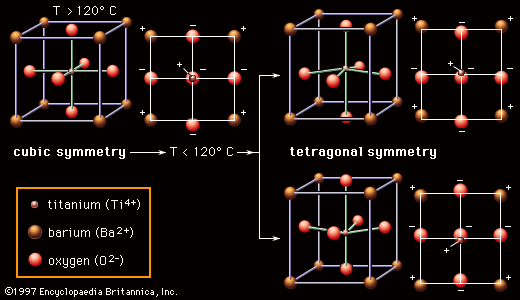
Below the Curie point, barium titanate undergoes a structural transition from a cubic to a tetragonal crystal structure. This shift causes the titanium ion to move off-center, creating a permanent electric dipole within the unit cell. These dipoles spontaneously align in local regions called domains.123
In a capacitor, the application of an electric field allows these domain boundaries to move, causing domains aligned with the field to grow at the expense of others. This process produces a large net polarization, which reduces the strength of the electric field between the electrodes and thereby allows for a significantly greater amount of charge storage. This high susceptibility to polarization makes barium titanate and related perovskite compounds highly effective as dielectric materials.12