
Britannica
Sources used in this answer
How does damping make a gyrocompass settle on true north?
Created from Britannica articles
using AI.
AI can make mistakes, so verify using Britannica articles.
gyrocompass
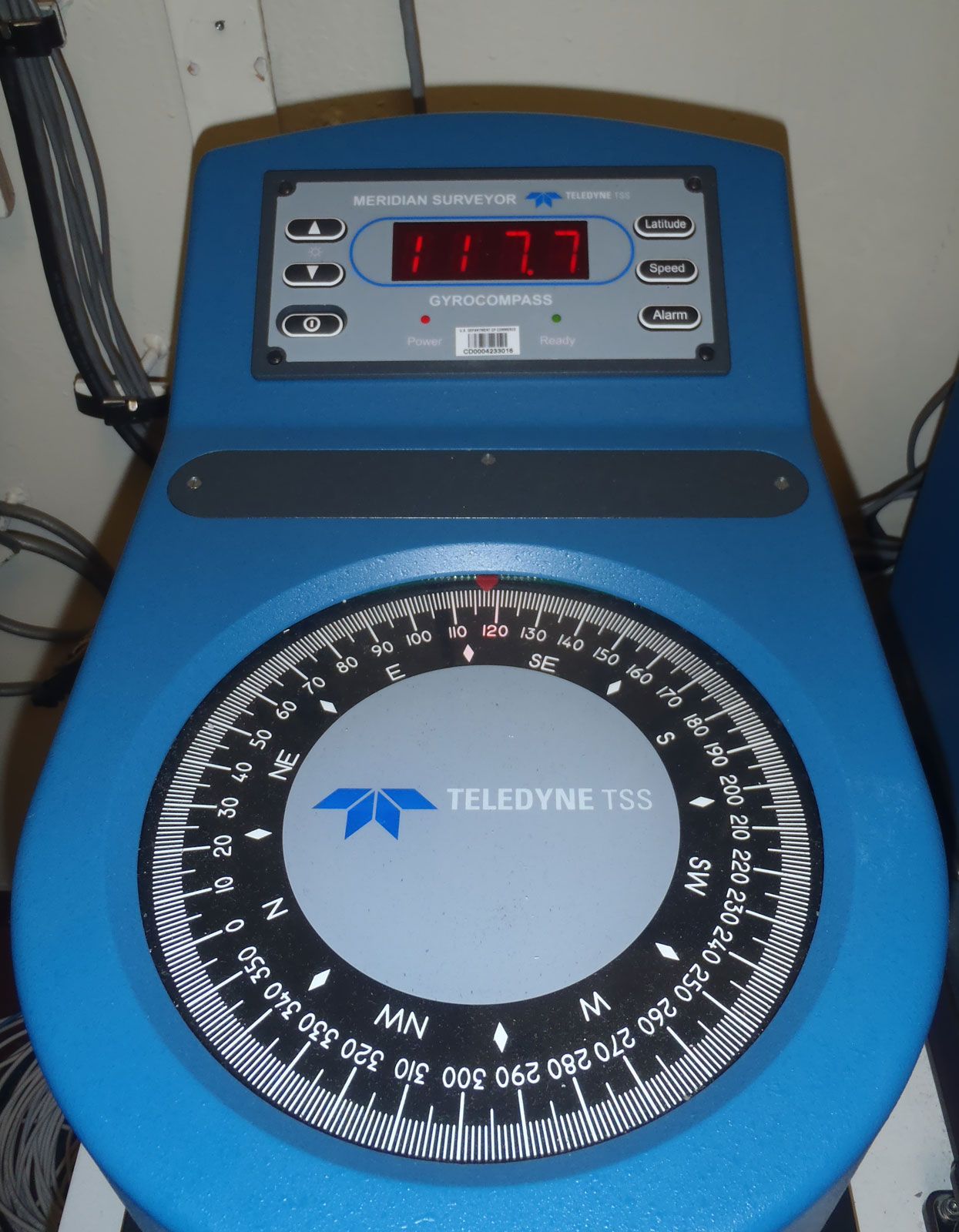
The gyrocompass aboard the National Oceanic and Atmospheric Administration's (NOAA) ship Rainier. Gyrocompasses are navigational instruments that use a continuously driven gyroscope to accurately seek the direction of true (geographic) north.
A gyrocompass naturally oscillates in an elliptical path around the meridian due to the interaction between Earth's rotation and the instrument's pendulosity. Without intervention, the spin axis would continuously pass through the meridian rather than settling on it. Damping is the process of removing this oscillatory energy to force the unit to stabilize on true north.1
There are two primary methods used to achieve this:
- Viscous Damping: Used in most gyrocompasses (such as the Anschütz and Arma), this method employs the restricted flow of a viscous fluid. By responding to the tilt of the gyroscopic element, the fluid creates an antipendulous torque. This torque is applied in the correct phase to precess the gyroscope toward the meridian, effectively changing the elliptical motion into a spiral that converges on the meridian.1
- Servomechanism Damping: Used in the Sperry gyrocompass, this method utilizes a power-driven follow-up system (a phantom ring). Damping is achieved by applying a torque along the vertical axis through the interaction of the pendulous torque and the follow-up motor. This process adds energy to the system to reduce the tilt of the gyroscopic element, causing the spin axis to settle on the meridian.1