
Britannica
Sources used in this answer
How does a piezoelectric gas igniter produce an electric spark?
Created from Britannica articles
using AI.
AI can make mistakes, so verify using Britannica articles.
capacitor dielectric and piezoelectric ceramics
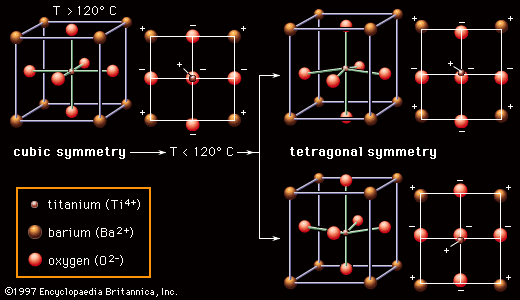
Figure 1: Ferroelectric properties of barium titanate (BaTiO3). (Left) Above 120° C the structure of the BaTiO3 crystal is cubic, and there is no net polarization of charge; (right) below 120° C the structure changes to tetragonal, shifting the relative positions of the ions and causing a concentration of positive and negative charges toward opposite ends of the crystal.
A piezoelectric gas igniter produces an electric spark by utilizing the unique properties of piezoelectric ceramics. These materials are capable of generating a voltage when they are subjected to mechanical pressure.1
In a manual gas igniter, the mechanical force applied by the user compresses the piezoelectric ceramic element. Because these materials lack a centre of symmetry, this physical stress causes a relative displacement of ions and a redistribution of electrons within the unit cell. This internal shift results in the generation of a high-voltage electric charge, which is then discharged to create the spark necessary to ignite the gas.21