
- capacitor dielectric and piezoelectric ceramics - Ferroelectric properties of barium titanate
- capacitor dielectric and piezoelectric ceramics - Piezoelectric ceramics
- electrostatics - Dielectrics, polarization, and electric dipole moment
- dielectric constant
- capacitor dielectric and piezoelectric ceramics
- capacitor dielectric and piezoelectric ceramics - Barrier-layer capacitors
- electricity - Dielectrics, polarization, and electric dipole moment
How does a ceramic dielectric increase the charge stored in a capacitor?
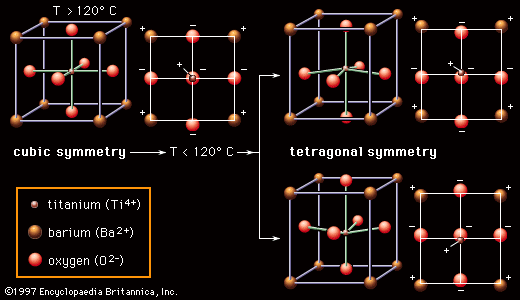
A ceramic dielectric increases the charge stored in a capacitor by undergoing electric polarization when placed within an electric field.12
Because ceramics are dielectrics—materials with poor electrical conductivity—their internal positive and negative charges do not travel freely. Instead, under the influence of an electric field, these charges separate slightly and align parallel to the field's axis, creating electric dipoles. In many ceramic materials, such as those based on barium titanate, this process is enhanced by the movement of domain boundaries, which allows dipoles to align with the field and produce large net polarizations.13
This polarization effectively reduces the strength of the electric field between the capacitor's electrodes, which in turn lowers the potential difference for a given amount of charge. By reducing this potential, the dielectric increases the capacitance of the device, allowing it to store significantly more electric charge than it could in a vacuum.134