
Britannica
Sources used in this answer
How do ferroelectric domains affect polarization in barium titanate ceramics?
Created from Britannica articles
using AI.
AI can make mistakes, so verify using Britannica articles.
capacitor dielectric and piezoelectric ceramics
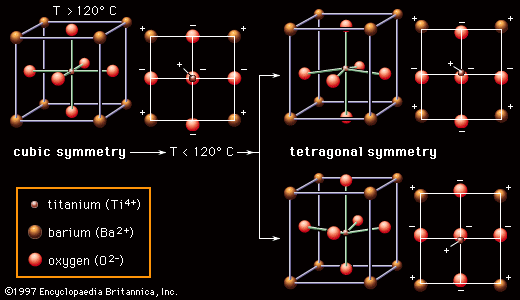
Figure 1: Ferroelectric properties of barium titanate (BaTiO3). (Left) Above 120° C the structure of the BaTiO3 crystal is cubic, and there is no net polarization of charge; (right) below 120° C the structure changes to tetragonal, shifting the relative positions of the ions and causing a concentration of positive and negative charges toward opposite ends of the crystal.
In barium titanate (BaTiO) ceramics, ferroelectric domains are regions where the internal electric dipoles are aligned in the same direction. These domains significantly influence the material's polarization and its effectiveness as a dielectric:12
- Spontaneous Polarization: Below the Curie point, the crystal structure shifts from cubic to tetragonal, creating permanent dipoles that cluster into these domains.13
- Net Polarization: In a typical ceramic, these domains are randomly oriented, leading to an overall cancellation of polarization.1
- Field Response: When an external electric field is applied, the boundaries between domains can move. Domains already aligned with the field grow at the expense of those that are not, producing a large net polarization.13
- Capacitance: This susceptibility to polarization allows the material to store significant electric charge, resulting in the high dielectric constants that make barium titanate essential for capacitor technology.12