
Britannica
Sources used in this answer
How do electrode area and electrode spacing affect capacitance?
Created from Britannica articles
using AI.
AI can make mistakes, so verify using Britannica articles.
capacitor dielectric and piezoelectric ceramics
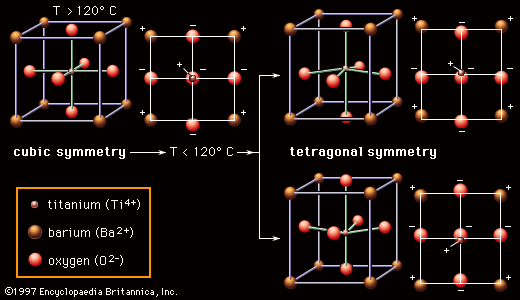
Figure 1: Ferroelectric properties of barium titanate (BaTiO3). (Left) Above 120° C the structure of the BaTiO3 crystal is cubic, and there is no net polarization of charge; (right) below 120° C the structure changes to tetragonal, shifting the relative positions of the ions and causing a concentration of positive and negative charges toward opposite ends of the crystal.
For a parallel-plate capacitor, the capacitance () is determined by the physical geometry of the device and the properties of the material between the plates. The relationship is expressed by the formula:
In this equation:
- Electrode Area (): The capacitance is directly proportional to the area of the electrodes. Increasing the surface area of the plates allows for more charge to be stored, thereby increasing the capacitance.12
- Electrode Spacing (): The capacitance is inversely proportional to the distance between the electrodes. Reducing the gap (spacing) between the plates increases the capacitance, as it strengthens the electric field effect for a given potential difference.12
Additionally, the use of dielectric materials, such as barium titanate ceramics, further increases capacitance by a factor of the dielectric constant (), which accounts for the material's ability to become polarized in an electric field.13