
Britannica
Sources used in this answer
- capacitor dielectric and piezoelectric ceramics - Disk, multilayer, and tubular capacitors
- electronic substrate and package ceramics
- capacitor dielectric and piezoelectric ceramics - Barrier-layer capacitors
- capacitor dielectric and piezoelectric ceramics - Piezoelectric ceramics
- electrostatics - Dielectrics, polarization, and electric dipole moment
How are resistive surface layers formed in surface barrier-layer capacitors?
Created from Britannica articles
using AI.
AI can make mistakes, so verify using Britannica articles.
capacitor dielectric and piezoelectric ceramics
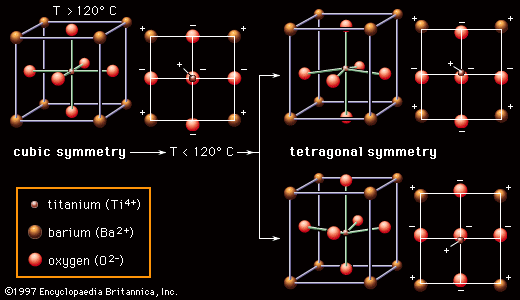
Figure 1: Ferroelectric properties of barium titanate (BaTiO3). (Left) Above 120° C the structure of the BaTiO3 crystal is cubic, and there is no net polarization of charge; (right) below 120° C the structure changes to tetragonal, shifting the relative positions of the ions and causing a concentration of positive and negative charges toward opposite ends of the crystal.
In surface barrier-layer (BL) capacitors, resistive surface layers are formed through a process of oxidation. Initially, conductive films are created on the ceramic material by donor doping or reduction firing. To produce the thin resistive layers required for the barrier effect, oxidizing agents—specifically manganese oxide or copper oxide—are added to the silver electrode paste prior to the firing process.1