
Britannica
Sources used in this answer
How are piezoelectric ceramics used in ultrasonic cleaning and drilling?
Created from Britannica articles
using AI.
AI can make mistakes, so verify using Britannica articles.
capacitor dielectric and piezoelectric ceramics
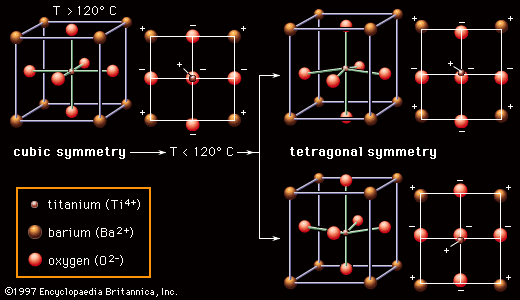
Figure 1: Ferroelectric properties of barium titanate (BaTiO3). (Left) Above 120° C the structure of the BaTiO3 crystal is cubic, and there is no net polarization of charge; (right) below 120° C the structure changes to tetragonal, shifting the relative positions of the ions and causing a concentration of positive and negative charges toward opposite ends of the crystal.
Piezoelectric ceramics are essential components in ultrasonic cleaning and drilling because they function as transducers, which convert electrical energy into mechanical energy.
In these applications, the ceramic material utilizes the converse piezoelectric effect: when an oscillating electric field is applied to the ceramic, it induces a mechanical vibration at the same frequency. By matching this frequency to the natural mechanical resonance of the ceramic, the intensity of the vibration is significantly amplified.123
- Ultrasonic Cleaning: The high-frequency mechanical vibrations generated by the piezoelectric transducer are transmitted into a cleaning medium. These vibrations create intense acoustic energy that effectively dislodges contaminants from surfaces.12
- Ultrasonic Drilling (Machining): The transducer converts electrical signals into high-frequency mechanical oscillations that drive a tool. This rapid, repetitive motion allows for the precise removal of material, which is particularly useful for machining hard or brittle substances.12
While magnetostrictive materials are also used in these fields, piezoelectric ceramics are favored for their versatility and ability to operate across a wide range of frequencies and output levels.2