
Britannica
Sources used in this answer
How are ceramic disk capacitors manufactured?
Created from Britannica articles
using AI.
AI can make mistakes, so verify using Britannica articles.
capacitor dielectric and piezoelectric ceramics
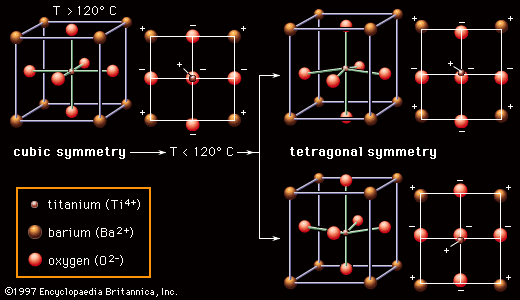
Figure 1: Ferroelectric properties of barium titanate (BaTiO3). (Left) Above 120° C the structure of the BaTiO3 crystal is cubic, and there is no net polarization of charge; (right) below 120° C the structure changes to tetragonal, shifting the relative positions of the ions and causing a concentration of positive and negative charges toward opposite ends of the crystal.
Ceramic disk capacitors are manufactured through a precise process involving the preparation of ceramic powders, such as barium titanate, which are often produced using liquid-mix techniques to ensure high purity and controlled particle size.1
The manufacturing steps for these disks include:
- Forming: The ceramic powder is either dry-pressed or punched from tape to create the disk shape.1
- Firing: The formed disks are fired at high temperatures, typically between 1,250° and 1,350° C (2,280° and 2,460° F).1
- Electrode Application: Silver-paste electrodes are screen-printed onto the surfaces of the disks and bonded at 750° C (1,380° F).1
- Finishing: Leads are soldered to the electrodes, and the final units are encapsulated using epoxy coating or wax impregnation.1
While disk capacitors were once standard, multilayer capacitors are increasingly used in modern electronic circuitry because they offer higher capacitance in a smaller, more robust form factor by interleaving dielectric and electrode layers.1