
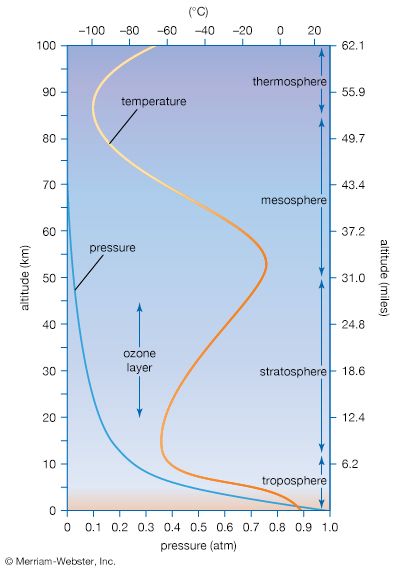
atmosphere, Gaseous envelope that surrounds the Earth. Near the surface it has a well-defined chemical composition (see air). In addition to gases, the atmosphere contains solid and liquid particles in suspension. Scientists divide the atmosphere into five main layers: in ascending order, the troposphere (surface to 6β8 mi, or 10β13 km); the stratosphere (4β11 mi, or 6β17 km, to about 30 mi, or 50 km); the mesosphere (31β50 mi, or 50β80 km); the thermosphere (50β300 mi, or 80β480 km); and the exosphere (from 300 mi and gradually dissipating). Most of the atmosphere consists of neutral atoms and molecules, but in the ionosphere a significant fraction is electrically charged. The ionosphere begins near the top of the stratosphere but is most distinct in the thermosphere. See also ozone layer.
verifiedCite
While every effort has been made to follow citation style rules, there may be some discrepancies.
Please refer to the appropriate style manual or other sources if you have any questions.
Select Citation Style
atmosphere summary
Learn about the layers of the atmosphere
Below is the article summary. For the full article, see Atmosphere.
atmosphereIn Earth's atmosphere, the limits of the atmospheric layers are approximate and variable, especially with latitude. Most weather occurs within the troposphere. The ozone layer, which absorbs most incoming ultraviolet radiation, forms part of the stratosphere. The thermosphere extends hundreds of miles above Earth's surface and is bounded by outer space. Atmospheric pressure drops off steadily with altitude, but temperature rises and falls through successive layers in a more complex manner.
